 |
Carole
|
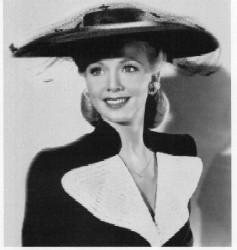 |
Last updated:
|
|
Carole
|
|
Even when he was not thinking of the little phrase, it existed latent in his mind on the same footing as certain other notions without material equivalent, such as our notions of light, of sound, of perspective, of physical pleasure, the rich possessions wherewith our inner temple is diversified and adorned. Perhaps we shall lose them, perhaps they will be obliterated, if we return to nothingness. But so long as we are alive, we can no more bring ourselves to a state in which we shall not have known them than we can with regard to any material object, than we can, for example, doubt the luminosity of a lamp that has just been lit, in view of the changed aspect of everything in the room, from which even the memory of the darkness has vanished. . . . Perhaps it is not-being that is the true state, and all our dream of life is inexistent; but, if so, we feel that these phrases of music, these conceptions which exist in relation to our dream, must be nothing either. We shall perish, but we have as hostages these divine captives who will follow and share our fate. And death in their company is somehow less bitter, less inglorious, perhaps even less probable. (Marcel Proust - Swann in Love)
During the last week of January 2003 I had an experience that changed
my life in ways still incalculable, albeit not wholly involuntary. As is our
wont, despite the many reasons to the contrary--books to read, books to
write--my wife and I watched on Turner Classic Movies I Wake up Screaming, a 1941
production starring Victor Mature and Betty Grable. Also in the film, one Carole
Landis, a suicide, described by the ineffable Rex Harrison as no actress but a
beautiful girl. As the film began, I was struck by a powerfully yet elusively
beautiful Grable, remarking that her features were far more delicate than I
recalled. When Grable’s sister appeared somewhat later in the film, my first
reaction was that Carole would have had good reason to commit suicide had beauty
been her only claim to livelihood. But then I realized that I had the two
sisters of the film reversed.
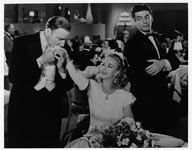
Enthralled by this woman whose long, full-bosomed body possessed an unemphatic grace unavailable to the touted beauties of the screen, I sought a image of her on the Internet, often my source of wisdom and sometimes salvation, and found the most beautiful thing I have ever seen.
This photograph at scarcely more than thumbnail resolution brought to my eyes the taste of Proust’s fictive madeleine. There entered into me the knowledge, fictitious perhaps yet uniquely real, that this image held the truth of the biological and cultural conglomerate I call myself. It seemed to me that, discoverer of the origin of language though I may be, I had been sent into the world, for over sixty years unknowingly, to witness the beauty of Carole Landis and to rescue her from what the French call untranslatably, oblivion connoting rather a bottomless pit beyond forgetting, l’oubli.
* * *
Writing this now gives me a pleasure I have experienced in the past only in those moments of writing poetry for the one I love, most recently and in greatest volume to my wife. I would not write poetry for Carole, she not being alive to read it but above all needing from me not the expression of desire or idolatry but what alone the love of a fellow-creature can give beyond death: a true appreciation of her worth.
The hedgehog who dares to claim, if only to himself, to have raised up the riddle of human origin to a new level, the Bronx romantic infatuated with modes long abandoned, embarrassed less by the reader’s anticipated reaction than by the sad promiscuity of a life led and lost in Hollywood’s no-man’s-land--no man, so many men--between starlet and star, obliges himself to tell the story of Carole whom I strangely feel I know and the sight and awareness of whom, as Proust says of the petite phrase and her companions in art, makes death seem to me less bitter, less ignoble, in some far-off sense less probable.
Sadness and pride, presence and absence, the exquisite equilibrium of art yet more than art make of this portrait the most beautiful of images, beautiful in a way no longer possible or necessary, beauty for all to see, yet for me alone to witness, to make from its light a new trace that the world may now acknowledge--or yet ignore, because such beauty in our world fulfills no purpose. Unavowable in the nascent postmodernity that condemned Carole, beauty has never ceased to move us to desire and beyond; in our postmillennial age it can reemerge and, as Raoul Eshelman might say, perform itself in the screen stars of our day, more beautiful than those of the past, than all but she. For the renewed sublime today’s beauties inherit, like the one God of all particular to the Jews, was first hers and so of necessity less in them than in her. Today's invented and performed sublime can only point to the exiguous moment of history when the vulgar Hollywood display of leg-art, pin-up, cheese-cake attained sublimity by freely offering itself as the gift of one who transfigured this freedom to sublimity by renouncing it.
A character in a drama not our own, ritual rather than fictive, Carole turns her face from the camera while leaving it fully exposed; the sadness and pride of her expression balance on the razor’s edge of this unique instant when its mortal sharpness is no metaphor. Her eyes wide open, she offers her bosom’s sweet generosity (Carole four times married died childless). The line of her hips suggests her long, graceful legs; the fold of the dress, the discreet core of her sexuality. The dress itself, the golden hair, whose gaudiness she bears with proud humility, are the trappings of royal sacrifice--the princess offering herself, the ultimate gift.
Although the madeleine’s taste remain, its revelation fades do we not grasp it. What of world-history have we here?
* * *
I will learn if I must in libraries and archives dear Carole’s sad fate. For now I tell what I know now--this beauty was a pure gift of love for life at its last crucial battle with death.
How many movie actresses, aided or not, have published a book before the age of twenty-five? A memoir of the War before the war was even over? Carole’s 4 Jills in a Jeep is, as she tells us in the preface, based on the diary she kept during what she calls "five wonderful months of my destiny." This book indeed contains her destiny. It rings too sincere to be doubted in its narrative, whose external facts are all well attested. Carole gives us her self through her self-image when embedded in a chosen world that gives value to her and her actions, all acts of generosity.
Carole is wholly typical of her time yet unique in the way she assumes this typicality. At the outset she insists on her desire to participate in the war effort even before Pearl Harbor brought the US into the war. She took flying lessons in hopes of joining a British women’s squadron. Greater even than her patriotism is her desire to serve in any capacity, not preferentially that in which her service was given, in entertaining the boys. For Carole was a singer before she was an actress, and she went abroad not to act but to sing.
 Throughout the book, Carole is constantly impatient; but the impatience is
never to get but to give. She is impatient to be chosen for a tour, impatient to
begin it, impatient for her planes to take off. Impatient as well to marry the
husband of her third failed marriage, the object of a coup de foudre to
which experience should by this time have made her immune. The story of her
marriage in England hours before her departure for a tour of duty in North
Africa is, like that of the book as a whole, of which the encounter and marriage
form the narrative armature, gay and uncomplicated, and only retrospectively
pathetic. The final episode of the chapter begins, words too poignant for words
from the
pen of one who would take her own life less than five years later, "This story
has nothing but happy endings" (179).
Throughout the book, Carole is constantly impatient; but the impatience is
never to get but to give. She is impatient to be chosen for a tour, impatient to
begin it, impatient for her planes to take off. Impatient as well to marry the
husband of her third failed marriage, the object of a coup de foudre to
which experience should by this time have made her immune. The story of her
marriage in England hours before her departure for a tour of duty in North
Africa is, like that of the book as a whole, of which the encounter and marriage
form the narrative armature, gay and uncomplicated, and only retrospectively
pathetic. The final episode of the chapter begins, words too poignant for words
from the
pen of one who would take her own life less than five years later, "This story
has nothing but happy endings" (179).
In the course of the narrative, Carole has appendicitis and other digestive ailments, if not yet the malaria and dysentery she would catch on her later trip to the Pacific. Even for someone in the prime of life, she acts with ominous improvidence. She leaves nothing for a rainy day; her life is tactics without strategy. She revels in her ability to persuade and overwhelm until she gets her way, but the way she gets is to give still more than if she had not, the beautiful princess battling to sacrifice herself so that the bell might ring more pure.
The mystery of Carole that I have not yet, will perhaps never solve, is her inability to maintain a genuine love-relationship. We have to believe in her love-at-first-sight romance, but its happy ending lasted but a few months. The failure of love in someone whose gravestone inscription speaks not of her beauty but of her love, graciousness, and kindness is a mystery that sustains the more personal mystery of my own sense of kinship with this woman I know only as a bygone celebrity. I see her body crumpled on the floor and something tells me that I can, even now, protect her from herself--this absurdity holds meaning, could I unravel it.
Beneath serenely raised eyebrows, her perfect eyes draw me into them, making
me weaker and stronger. This is the beauty of a unique moment that I am privileged to recapture. The war gave glamour photography
ethical
legitimacy--Carole’s beauty, a gift to the boys, took itself out of commerce. But
the war is over, the gift can no longer be given. To show herself is to
prostitute herself to our regard, yet in showing herself she hides
herself. Sadness and pride, presence and absence, all is reflected in those
beautiful eyes that look away into nothingness.
moment that I am privileged to recapture. The war gave glamour photography
ethical
legitimacy--Carole’s beauty, a gift to the boys, took itself out of commerce. But
the war is over, the gift can no longer be given. To show herself is to
prostitute herself to our regard, yet in showing herself she hides
herself. Sadness and pride, presence and absence, all is reflected in those
beautiful eyes that look away into nothingness.
A photograph in Life magazine shows Carole looking on as Cecil B. de Mille gives blood for the war effort, herself a donor, curious to give her substance to her countrymen.
I have so much yet to learn about you, Carole, and about myself as one humbly drawn to you by the media, this sacrifice of cultural identity gladly offered to you whom I know as I know myself, but only through their mediation. You will never know me, I will ever know you, yet what is love but unresented asymmetry? This one moment of revelation reconciles me with celebrity, to which I sacrifice so much less than you.
One pure moment of beauty revealed to me across six decades--lost time I would regain. My own greatest gift to the world would be to reveal to it that revelation. However well I understand our human origin, something in you speaks to me of my own, the origin of a certain originary thought. I will learn everything about you, Carole, and more than that, I will make the world remember you, who have returned me to my memory.
Is the purpose of this lesson to teach me the limits of indifference? I cannot denounce what your sublimity owes the imitation of the world’s desire. It is you who free me by your look from the infernal circle. Only in this vulgar context could you guarantee my pledge. You are not mine but the world’s and I proudly and arduously recall you in the constant reassurance that you and therefore I exist. Here at the beginning, you will be there at the end, however long my task.
Carole’s command performance:
Now it was my turn again. I had to go out and sing "Deep in the Heart of Texas," and I couldn’t for the life of me remember the lyrics. . . . "This is sure one hell of a Command Performance," I thought as I came on the stage, "something to write home about."
"Well, here goes," I thought and plunged headlong into song. Imagine my relief when all the boys joined in, some two thousand of them singing "Deep in the Heart of Texas," some four thousand hands going clap clap clap clap and the little princesses down front singing, too, for all they were worth and clapping their hands like mad. Then it didn’t make any difference after all whether I knew the lyrics or not.
I finally summoned the courage to look at the Queen, and I thought she was smiling at me, but I wasn’t sure, so I looked again and, yes, she was smiling and looking up and she sort of nodded her head, and suddenly I felt so happy I felt I could remember every song I had ever sung in my life. (81-82)
How could one not wish to preserve forever this modest instant of happiness, blessed by a queen, leading thousands far from home in a song of someone’s native land? The end of this happiness is the sadness by which your beauty becomes sublime.
Language is the tool of consecration; every name a name of God. Through you I consecrate my lost beginnings. Un seul être vous manque, et tout est repeuplé. I recall the happy moments of my childhood without affect. My mother teaching me to read in father’s wing armchair, visits to museum dinosaurs, I vaguely remember but no emotion accompanies them. It is seeing your photograph in Life that is precious in that dead past.
If I imagine Carole in my world at all, it is not as lover or wife, but as an older sister I would have loved and admired and protected from herself.
We live in a performatist age; Carole is my performance.
What guarantees these ephemera is you, your beauty and what it stands for. Should people read this, however unworthy, for your sake, I will have triumphed, not in myself but in my cause.
The Foreword tells us how, dining at the Stork Club in New York, an officer had given Carole a copy of a standard-issue soldier’s diary.
The book was bound in imitation leather and on the blue cover was a red shield topped by an eagle. The shield bore this inscription in gold: "My Life in the Service."
Almost any fellow in the service would recognize the book. During the several months I was to spend in England and North Africa doing shows for the boys, I was to come across hundreds like it, produced on all sorts of occasions. But it was new to me then, and, as I glanced through the blank pages carefully ruled in red ink, I was thrilled. . . .
I read the introductory paragraph: "Your experiences in the armed forces are your part of living history. Keep a diary! Times without number, historians and writers have found more information of real human interest in the diaries of enlisted men than in the studied accounts of generals and admirals. This book, conscientiously kept, may prove to be the living record of your destiny five hundred years from now."
Properly awed, when I got back to my hotel that night I turned to the section titled "The Following Pages Contain the Diary of my Life in the Service," and wrote my name and address in the allotted space underneath, and the date, October 25, 1942.
Oh, unknown historian five hundred years from now! Here is "the living record" of five wonderful months of my destiny. (viii)
No narcissist could have written these lines. Carole is eager to identify with the servicemen to whom her book is dedicated. Her book is that of a movie star who humbly invests her status in her service and whose writing seeks only to inform us of this investment. Her only book reveals beyond her possibility of knowledge that these would indeed be the "wonderful months of her destiny." All the tinsel glory of Hollywood is suddenly cashed in beyond the nexus of the market, in the pleasure these shows gave to the "boys." During these "wonderful" months, Carole came down with appendicitis and underwent all kinds of inconveniences, which only made them, and Carole herself, all the more wonderful. Reading these pages, one begins to understand why there has never been, can never be again, a beauty equal to hers.
This inauguration is preceded by a more frivolous introit:
I have always had a poor memory for names. When I told the New York correspondent of the London Mirror I had a dinner date in London with an RAF wing commander I had met the night before at the Stork Club whose name I couldn’t remember, I wasn’t trying to be mysterious.
When I arrived in London about two weeks later, however, I discovered that the papers had made up their own mystery story. The first headline in the Mirror that struck my eye, after I had glanced through the war news, was: WHERE IS CAROLE’S WING COMMANDER? The Sunday Pictorial had also joined the manhunt with the caption: WILL SOMEONE FIND CAROLE’S WING COMMANDER?
For several days after that the papers kept publishing telegrams from British flying officers from all over the country. "Am not a wing commander," the telegrams said, "But will I do?" . . .
Finally my dinner date did show up at the Savoy where I was staying. His name was O’Neal, and his greeting, I fear, was a little on the chilly side. I felt he wasn’t quite sure I hadn’t used the whole Royal Air Force for a publicity gag. These Hollywood people, you know. But the pay-off came when the Stars and Stripes ran a picture of us shaking hands at the Savoy bar, under the title: LONELY HEARTS COLUMN. "We found Carole’s wing commander," the caption stated. "Can we find your sweetheart for you?"
But I’m getting ahead of my story. . . . (vii)
This is followed directly by the anecdote of the diary in which Carole inscribes her name.
Several things are of interest in this passage. It is the only allusion in the book to Carole’s celebrity status independent of her war role; the only mention of her name in newspaper headlines; the only allusion to her public, as opposed to her immediate, desirability. ("Distractingly desirable" a 1940 Life article had called her.) When in the course of the main narrative she comes to her stay at the Savoy, this incident is not alluded to. Instead, she narrates the onset of the reciprocal love-at-first-sight romance that culminated in her second marriage.
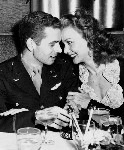
I looked up into the steadiest blue eyes I have ever seen, and the eyes under the heavy sandy brows kindled into a smile that was divine, and suddenly, everything stopped inside me; everything went boom, boom, crash! and my knees felt weak.
What’s the matter with me? I thought, and to hide my panic I turned away and took a sip of tea.
(Later, when I asked Captain Wallace how he felt at that moment, he said
that exactly the same thing had happened to him. Then,
 when I turned away,
he had said to himself, "Oh, a snooty movie actress! She’s going to do me a
favor by talking to me.") (43-44)
when I turned away,
he had said to himself, "Oh, a snooty movie actress! She’s going to do me a
favor by talking to me.") (43-44)
Thus once the Foreword has established her extra-narrative celebrity, her asymmetrical relationship with the rest of the world, the story itself insists on the symmetry of desire that drove her, considered for the moment as a character in her story, to what was subsequently revealed to be an ill-considered marriage.
We should read this book as Carole’s Recherche du temps perdu. This was the wonder-moment of her life, romance the happy ending of her story, and this passage from hierarchy to symmetry, the sacrifice that gave value to the efforts that had brought her fame, that had transformed her from a beautiful girl into a desirable star.
In the course of the book, Carole meets someone from home:
As I was fooling with my chow . . . a boy came up to me and said, "Hello, Carole, how are you?"
"Gosh, fine," I said, trying to recall where I had seen him before.
"How’s your mother?" he said, "Golly, it’s good to see you, Carole. Imagine seeing you here."
"Yes, imagine you being here," I said, making an effort not to look too blank while I racked my brains trying to remember him.
"How’s Diane?" he said. "How’s Skeeter?"
"Look," I said, "I’m awfully sorry. This is brutal. You know my mother, my niece and my nephew and I can’t even remember your name."
He looked at me amazed. Jerry," he said. "Jerry Skolsky from back home. You know me, Carole, don’t you?"
Did I know Jerry! I had gone to school with him and he was always over at the house. Now he had been gone a few months, here in Africa, and I didn’t even recognize him, he had become so mature, so grave.
"Gee, the Army has changed you a lot, hasn’t it?" I said.
Jerry shook his head thoughtfully. "Not the Army," he said. "The Nazis."
"Why don’t you girls come over to our place," he added "and give us fellows a break. We haven’t seen a white woman for so long we’ve almost forgotten what they look like." (161-62)
This is the only mention in the book--the book that is her life--of Carole’s family and her pre-celebrity life. In her forgetting of Jerry we first see evidence of the repression of this life, but the final explanation is not that Carole has changed or been changed too much to recognize someone from her past, but that it is he who has been aged by an experience of evil incommensurate with her Hollywood tribulations. Thus his request that the "girls" come over to his camp--a request immediately acceded to, although his camp was twenty miles away and the lodging consisted of a pup tent with a straw floor--is not phrased as a tribute to celebrity but as the most generic desire possible, that of seeing a woman of his own race. When indeed Carole describes the ensuing performance:
"Oh, hello," we said, squirming with the straw down our backs and trying to look nonchalant, like magazine glamour girls. But the boys didn’t mind. The show was a big treat for them and they loved it. (163)
she presents herself and her comrades as trying to look like something they already were but presumptively were not, while secure in their success in giving the boys a treat merely as "white women."