 |
Carole
|
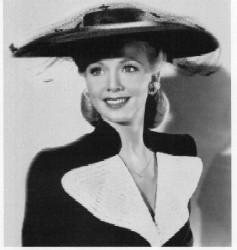 |
Last updated:
|
Carole
|
|
5/1/2003
Spent the whole day at the Academy library going through their (rather small) special collection on Carole. Most of the material seems to have come from one Shirley Baxter who was president of Carole's fan club. There is, among albums, a scrapbook, and a few postcards, a letter from Carole to her fans from England, the last Christmas of her life: six single-spaced pages, perhaps typed by her secretary, but undoubtedly dictated by her. Also some very sad letters concerning her death. Original documents give off an emotion far more powerful that that engendered by the same text reprinted. The hands that touched them or typed them may have thrown a shovelful of dirt on Carole's coffin.
The emotion was so great that talking about some of the letters to Stacey made me burst into tears, in a way I can't recall crying since childhood. My father had an glass water bottle that he kept in the refrigerator, a narrow shape to accommodate the limited space near the freezer compartment, many times smaller than today's. The bottle was rounded at the corners and the glass decorated in a large grid pattern. One day he (not I, for I should have remembered the incident very differently) dropped the bottle and it broke. I was inconsolable, and although a new bottle was soon purchased, I rarely drank from it; in fact, I've hardly drunk water since--at least not for pleasure. Today I cried the same way, except that there is no new catastrophe to react to, merely one 55 years old. The feeling is so genuine, almost too genuine, as though I had lost touch with the everyday world.
I am too tired now to do this subject justice; I will return to it tomorrow.
5/2/2003
Carole's beauty provides repose from the violence of (sexual) desire; to gaze at her is to experience not passion but serenity. A haunting passage from her sister's letter to her fan club after her death: "There was a school friend, Peggy Freeman, who adored Carole, even before she was in pictures. We three used to sit on the school lawn enthralled with Carol's singing, her grace and beauty." About whom else has such a thing ever been said? Could ever be said? I can see myself sitting beside those two girls, equally and as innocently enthralled--I sit here now enthralled without her presence, without her voice, without the joyous hope of her blossoming future--by her grace and beauty. Carole reinterprets for us the Incarnation as the guarantee of the transcendence of human desire by human culture. If sexual desire can be so transcended, than so can any desire. The troubadours and their followers in Italy and France began this understanding of the Incarnation; they intuited that desire was the source of the sacred, so that desire for union with a woman was analogous to and could be seen as part of desire for union with God. This passage from worldly desire to its transcendence lacks, however, an explicit mediation by the esthetic: desire is supposed to transcend itself, by itself. The woman's beauty may be "divine" but in this figure it is desire's intensity that itself brings about the transcendent appreciation of its divinity. These poets did not share the sweet ecstasy of those of us enthralled with Carole's grace and beauty, already given to others without reserve: "As I have said previously she never talked about the nice things she did for others. She just 'tossed the bread upon the waters,' and knew the kindness would go on and on." That kindness from the world has been owed Carole for 55 years. Cesar Romero in his own condolence letter was more realistic: "I only wish that life had treated you as kindly as you treated it."
Between Beatrice and Carole our society's exchange system evolved considerably. The market as a straightforward exchange medium between two presumably rational subjects was supplemented by the vast symbolic superstructure of what we call "consumer society." And in a place of choice within this superstructure we find the "media," by means of which these symbols are communicated. Carole's beauty was inseparable from these means of public communication; from her earliest years, she wanted to be an entertainer, she mimicked her favorite stars, and as she grew to puberty and real, dazzling beauty, she must have seen this gift of grace as an emerging guarantee of her marketability.
It was to her body that Carole owed her chance at success in film. In a world of pretty girls, there was none to compare with Carole. But Hollywood had no mode in which to appreciate the "grace and beauty" that had enthralled her sister and friend. By dint of great effort Carole made a career for herself, and received the lucky break of being chosen for a part in a film that, above nearly all others, put an emphasis on Carole's natural endowments: One Million B.C.--a part she won because she alone could run like an athlete rather than a "girl." Paradoxical as it may sound, we should say that Carole slipped through the cracks rather than that her early success was inevitable. Curvaceous Carole was too "distractingly desirable" to figure in a film narrative. There is a welcome frankness in all these transparently euphemistic references to her bosom; but they nevertheless miss what is most essential, what her sister named so easily, her "grace." This is not simply gracefulness, it is also "graciousness," a word that figures on her grave between "love" and "kindness." I think it was this grace that allowed Carole to pursue her career, because it took the edge off her sexiness. What was missed, and what made her career so problematic, was that grace's transmutation of desire into beauty was, albeit more subtly, even more distracting than her desirability; Carole is an artwork unto herself, whose inclusion in a film, however well she plays her role, is never altogether credible.
I can see her beauty today, detached from any story including her own. Perhaps it is only when the passage of time has made her natural death natural that we can get beyond its circumstances to see her as she was, and regret her anew. Nearly every viewer of Carole's photographs gasps in disbelief. How has such beauty been hidden for so long? I may be less constrained than most in praising it, but I do not invent it. But precisely, although intrigued by her appearance in I Wake up Screaming, I only really grasped the degree of Carole's beauty from still photographs. For the picturegoer of 1947, who saw Carole as a near-major star despite the weakness of most of her films, the photo would only point toward the movie or to its lived surroundings. Today her movies, with one or two near-exceptions, are animated photographs, images and sounds of Carole, story be damned. When my video collection is near or at its maximum, I intend to make a highlights tape (or perhaps two, one for songs) of Carole's appearances in these films. Perhaps that is the only way to watch Carole, in a "film" made just for her, for us to enjoy her presence in our eyes and ears on whatever pretext. The patina of time.
5/3/2003
Last night we saw Manila Calling, a 1942 film about the ongoing war in the Pacific. It is presumably based on a real incident, in which soldiers captured a Japanese base on Luzon and set up a radio station to counteract Japanese propaganda in the Philippines. However true this may be, it is the most pessimistic American war film I can recall. At the end, aside from two members of the original group who managed to escape in a refurbished plane, everyone is dead aside from Lloyd Nolan (whose character is named "Lucky"), a native Filipino (and extremely poor actor), and Carole, who could have flown off but remains behind having found in Lucky a région où vivre, an end to eternal exile. Nolan is dramatically shouting into the mike "Manila calling! Manila calling!" while bombs from a Japanese bomber fleet fall all around them; as the film's ending suggests no route of escape, we are clearly meant to assume that Lloyd and Carole will go down with the ship. Since setting up the freedom radio is the central task of the film, it is highly unbalanced plot structure to begin broadcasting only in the last five minutes under heavy bombardment. Perhaps this is was wirklich geschehen ist but since they bothered to add Carole to the mixture--the chances of a woman, let alone a beautiful one, finding herself in a place like this are those of winning the lottery--they might have given a little more play to the radio broadcast. Instead, the characters die off one by one in some pretty corny death-scenes, while the ever-dwindling group occupies itself not so much with setting up the generator to power the transmitter (job of Cornel Wilde, the engineer, who is injured and escapes in the plane) as with the dwindling water supply, the Japanese having disabled the pump. There's not much water left at the beginning of the siege, and yet no one complains much about thirst as the film goes on, let us say because most of the characters die off.
What about Carole's performance? She does a credible job playing a dance-hall girl (at one point she quasi-biographically refers to doing the hula, certainly as credible in Manila as in San Francisco) who has come to the island to marry a wealthy plantation owner who throughout the film urges surrender, then tries to blow up the generator to end hopes of the radio, is caught red-handed by one of the soldiers, and after killing his captor with a knife in the back is executed by Nolan as one-man firing squad. But well before this, Carole, who at first was hyper-predictably treated with contempt by Nolan, had already changed her mind about money over authenticity; she cares for the wounded, and again hyper-predictably wins Lucky's respect, at the end linking her life to his. I wonder how much this film, penultimate in 1942, influenced Carole to get busy with her four jills operation, for which she was the driving force throughout. She probably didn't need more than a poster.
Manila Calling does not particularly show off Carole's beauty; in her first appearance, she has a smudge on her face, and there is certainly no soft-focus dwelling on it; I don't recall a single close-up. The film seems to introduce her as a distraction from the masculine affairs of war and, as Stacey pointed out, to permit the hero, whose military posture is exemplary throughout, to "evolve." To this end, the film makes use of the rather tired cliché of the man (or woman) disillusioned by a single pre-plot betrayal into distrusting all other members of the opposite sex, but whose faith in this sex and by extension in humanity in general is restored by the encounter in the story. Of course a cliché is redeemed when it is performed with an original twist or flair, but in this case there is simply not enough attention paid to the love story to make the participants come alive. Carole portrays ("is" as the pub releases say) the dance-hall girl very convincingly, as both a feat of acting and a reflection of her own experience, above all because the combination of her beautiful body with a face not at its freshest, or made up that way, suggests the paradigm of one who has lived by her looks but has reached the point of diminishing returns. This is a poignant and immensely likeable portrayal that Carole makes very believable, but the overall effect is dampened by the failure of the film--more particularly, of the director--to create at any point a haven for the couple even within the frame of the shot. (The final shot shows Nolan still theatricalizing into the mike with Carole huddled against him, while the bombs crash and the building shakes, perhaps for the penultimate time; saved by the bell.) Like all the other elements of potential tension in the film, the love story is just added on rather than played off the others; this is a film without poetry.
When Carole is flawlessly beautiful, she makes you want to cry. When her beauty shows its precariousness, you want to cry then too. No one is more moving just being alive than Carole, all the more because there's nothing victim-like ("victimary," I would say in other contexts) about her. Her whole being exudes uncomplainingness. Uncomplaining in death, too--never one to ask for an advance on our sympathy.
* * *
It's hard to talk about the personal materials I read on Thursday. There are so few of them; a single letter to her fan club; two letters from her secretary about her suicide; a very sweet posthumous letter to her from Cesar Romero that shows what a fine man he must have been. Or the article under her name in Silver Screen (9/47) entitled "Do you think I was wrong?" (probably redacted by Gladys Hall) where she talks about her mistakes, her desire to do better. In her personal life, Carole is always making mistakes, always admitting them--then always making them over again. In the questionnaire for her fans, the first question "Who is your severest critic?" answered "I think --- Carole." I can see her writing, or dictating, that; or another sentence in Hall's notes for an article about the (then happy) marriage with Schmidlapp, something like: "Is he interested in Carole Landis --- or Carole??" That lovely identification with the name, chosen rather than accepted, so all the more hers. (Wouldn't it be still better if he were interested in Frances Lillian Mary Ridste?)
All the immense sadness of Carole's life is here, but also the joy she brings us that we honor her memory by sharing. Here is the heart of the matter, the paradox that made her beautiful and killed her--"Drop Dead Beautiful" would be a catchy title for her book, but too cruel--that permitted her to give herself to millions and left her terribly alone, that allowed her to exchange love with so many others--people who must have adored her as her secretary did, mourning her lovely lovely Carole whose throaty velvety voice she would never hear again--yet never to share love's genuine intimacy. It is her situation in Hollywood history, not unique in itself, made unique by her grace and beauty sadly recollected from a moment when mortality was only joy in living.
The magazine articles that Carole didn't even need to write for herself tell all her story. I will spend many hours gathering secret details that are already superfluous (for I want this book to be about Carole, not like a love-poem that is about the author: what do we know of Beatrice and Laura except as tools for poets' fame?); the truth is right there, hid in plain sight like Poe's purloined letter. I don't have the text with me to quote, but it's all in the two Hall manuscripts: "What Carole Landis Demands of Men!" (Screenland 10/41) and "Interview: Glamour Girls Are Suckers" (Photoplay 12/41). It's both a surprise and not that these articles were written pretty much at the same time. What is outlined here is not a process of disillusion but an unending oscillation, a dialectic with no resolution, that generates through a set of mediations that my task here is to set forth not merely the familiar binaries of great joy and great unhappiness, great dignity and great tawdriness, but Carole's unique, marvelous beauty, irreplaceably lost yet eternal.
In the first article, Carole lays on the line a set of criteria for love and marriage that she would throw to the winds scarcely a year later with her marriage to Thomas Wallace. The man must be gallant and attentive to a fault; he must supply a dinner corsage that presciently matches her dress; give lovely and thoughtful gifts, take her to the finest places, above all want to be with her but not to be seen with her. Well-meaning people who have called Carole a feminist (one sympathetic website speaks of her "ardent feminism") should meditate her statement that equality of the sexes is "the bunk" and that men are or should be superior to women in nearly every area; certainly she will only go out with men at least fifteen years older (Wallace was close to her age, Schmidlapp but 5 years older--looking 20) who can talk to her about refined subjects such as art and theater as she listens and learns. If Carole at this time was engaged in the kind of uninhibited sex life some people, on the strength of who knows which gossip columnists or all-purpose calumniators like Anger, have claimed, she certainly doesn't show it in this piece, where one of her demands is to visit the man's home so she can see how well conceived and decorated it is (I'm glad she won't have a chance to visit ours!). All these criteria, Carole, as the most beautiful of the lovelies of her day, could well impose them; one imagines she could take her pick of suitors. She insists here that it's the woman's privilege to do the heartbreaking, that she has learned from the experience of her previous (two-month) marriage that only a fellow thespian, or at any rate someone in show business, can make a suitable escort; she claims she's looking around for the ideal mate and that she'll find him in the near future; she cites the names of escorts she favors (another trait reconcilable with difficulty with an uninhibited lifestyle) as examples of savoir-faire, considerateness, good taste, and what have you.
These statements, clearly meant to be provocative, do not show Carole in a very favorable light; without appearing exactly vain, she is certainly selling herself dear. Yet, of course, the lady doth demand too much. The companion piece two months later, in a rival screen publication, shows the vulnerable underside that the subtle reader (supposedly my area of professional competence) should divine in the first.
5/4/2003
The "dialectical" contradiction between "What Carole Landis demands of Men!" and "All Glamour Girls are Suckers!" seems almost too obvious to mention; the two exclamation points point in opposite directions. Sucker Carole tells us of "the hurt spot in the heart," of her lack of smarts with men. She recounts an unhappy love affair with an unnamed actor (perhaps nameable by her better-informed readership) who left her for a "little girl, a non-professional, not pretty" whose vivaciousness was her only advantage--surely not over Carole! "I swear that I have never in my life been so terribly unhappy. And I have been married twice." The whole article in this vein. It is painful to read, because although it is a publicity operation, a publication in a movie magazine, written by a professional writer rather than Carole herself, nonetheless named as author of the first person text (a red-penciled note on the top of Hall's typescript: "Swell! -- Carole says "Thanks a Million")--it is clearly, painfully sincere. In contrast to the brazenness of more recent generations, whose confessions of their lack of moral inhibitions reads more like a boast, this kind of article is meant to attract the reader's sympathy more than her envy, and even to the exclusion of her envy. "I think I have always been a sucker . . . someone who is very vulnerable, wears her heart on her sleeve, easily hurt, almost asking to be hurt." Instead of the public persona as a mask, a guarantee against any embarrassing self-revelations in a text addressed to a world of strangers, here it seems to guarantee its opposite, a more extreme self-baring, not theatrical or melodramatic, but conveying a real sense of pain. The overall strategy of deferring the resentment of one's potential audience becomes the affirmation of a suffering so great that the author can no longer be resented. Glamour is paid for by suffering, and not just discursively. But how do we know? We must accept Carole's words as credible, despite the fact that they reflect a presumably successful strategy. The glamour girl's confession may be self-serving, it is so abject that we must recognize it as authentic anyway.
This would be the way into an inextricable morass were it not for the fact that the glamour girl's very existence in the milieu of publicity, that permits her to demand things of men, gives her assertion of pain plausibility. How CAN someone like Carole find happiness? Glamour girls are suckers because "we want so badly to have some sort of natural, normal life, to be just Two People who are just two people . . . we bend over backwards . . . to be Just a Person, an Average Girl." But whichever way the capital letters go, the glamour girl can't be Just a Person, for all-too-obvious reasons. Her suffering is the product of her difference-in-similarity to her audience. She has the same desires as we, but cannot find means to carry them out. Thus Glamour Girls "marry and keep on getting married."
5/5/2003
Today, although I faxed Fox the request to look at their legal files, called
the video man in Canada, received a couple of lovely images of Carole including
the famous Chesterfield ad and the Picturegoer cover she made for January
1, 1948--to look at her lovely and confident smile, her easy elegance so foreign
to our day and even to what would follow in a few years, her new year’s greeting
to her (British) readers, her handwriting just a little scrawled, not the lovely
line of her autographs, but hardly betokening the ominous, arm thrown back
casually behind her hair, one of so many facets in the gem of
 Carole’s
beauty, and think it was her last birthday--even left a message on the
Findagrave site asking any relatives or friends that might pass that way to get
in touch with me, I nonetheless felt a sense of discouragement, as though the
little energy I could muster was hardly what someone like Carole deserves. Then
I thought that one can succeed banally (like certain colleagues with whom I
should not dare to compare myself) or fail beautifully, that what attracts me to
Carole beyond an impersonal appreciation of her beauty is that she is the most
beautiful form of what I am on a lower plane, a "beautiful failure"--so that my
enterprise cannot possibly succeed. Such moments occur in the best of
circumstances; the intuition is generally true, one will not accomplish what one
hopes, yet that is finally irrelevant; I have made a commitment not only to a
dead woman but to all those who are in some way connected with her (which is why
I wanted to make this promise, virtually, on her grave) and my competence to
carry it out must be measured under fire. The metaphor itself reminds me how
little one risks in this brand of daring.
Carole’s
beauty, and think it was her last birthday--even left a message on the
Findagrave site asking any relatives or friends that might pass that way to get
in touch with me, I nonetheless felt a sense of discouragement, as though the
little energy I could muster was hardly what someone like Carole deserves. Then
I thought that one can succeed banally (like certain colleagues with whom I
should not dare to compare myself) or fail beautifully, that what attracts me to
Carole beyond an impersonal appreciation of her beauty is that she is the most
beautiful form of what I am on a lower plane, a "beautiful failure"--so that my
enterprise cannot possibly succeed. Such moments occur in the best of
circumstances; the intuition is generally true, one will not accomplish what one
hopes, yet that is finally irrelevant; I have made a commitment not only to a
dead woman but to all those who are in some way connected with her (which is why
I wanted to make this promise, virtually, on her grave) and my competence to
carry it out must be measured under fire. The metaphor itself reminds me how
little one risks in this brand of daring.
Tomorrow I will call Ned C. who has twice been recommended to me as knowing all about film; perhaps he has some hints at research angles. I have read most of what everyone repeats about Carole, yet I know really so little about her life during all this time. Enough for a story, not enough for a novel; for a book-length narrative, I must supply my own warp and let the woof fall where it will, an image made opaque by the archaic terminology.
The thought of my mission toward Carole, even if dead, makes the acceptance of failure more difficult even as it makes death less fearsome. It also makes success impossible. This is love terminally unrequited, whose entire energy comes from images, representations--culture, in a word, but culture is what makes love possible. The mystery of the Incarnation can only be experienced thus; this was a living woman, her beauty makes me feel she is still alive, yet knowing the contrary; when these dead images breathe life from my imagination, it is not I who animate them but her soul, a spirit that exists nowhere but in me, that will exist wherever I can give it life. This project has its ups and downs but never do I doubt my calling to it; Carole, more than the Bronx, is my homeland, to see her image is to return from exile, to receive across time a guarantee, so ineffably lovely, of my hedgehog existence.
* * *
"Glamour girls ‘marry and keep on getting married.’ ‘Here, God help me, is the truth: Right now I want marriage more than I want anything in the world. I want love, marriage, home, children …
… a sucker? Who? ME?"
The Glamour Girl wants marriage, home, children, everything the Average Girl can get without much trouble. The Average Girl "wants," needless to say, the beautiful clothes and the lavish, pampered lifestyle of the Glamour Girl. In order to maintain their relation in symmetry, the criterion of human exchange, home and children must be as impossible for the Glamour Girl as furs and the Stork Club are to the Average Girl. No one manipulates this system from without; it simply reaches its equilibrium.
The first article, like the second, is Carole’s authentic reflection on her reality. Marriage to Willis Hunt has taught her the impossibility of marrying outside her profession; a sampling of beaux has taught her what in her milieu can be taken as signs of love: bringing the right bouquet, caring for her and not her value in the date market. The man must be older and wiser to steer her through the contradictions of her state; able to appreciate not only her value but the effort she makes to acquire and maintain it, yet without himself needing to profit from it. For such a man, the Glamour Girl is a mere category of convenience, an Average Girl with a better figure, such as a man with a better income can hope to attract. If there is indeed a solution to her woes, it is here.
5/6/2003
Yet of course there is no solution. We all live the paradox of wishing to be "loved for ourselves" as though there were some inner core of the true self that is somehow intuitable by others. And, with some luck, we resolve the paradox in a benign way, finding someone to share our life who, in the absence of a hard and fast ontological distinction between inner and outer self, shares our own sense of the essential and the superficial, even helps us improve on it, telling us what tie or book or lifetime project is “really you.” But we are not Glamour Girls. Our appearance is not our profession.
But the word “appearance,” with its implicit counterpart “reality,” is insufficient; and the Glamour Girl is herself a poorly defined category. I can say with some confidence, without having made an exhaustive study of the Glamour Girls of 1941, that there were none to compare with Carole, because there has never been any public figure I have seen in film, television, music, modeling, or anywhere else who compares with Carole, not in “glamour” but in sheer beauty, which is not indifferent to but transcendent of glamour. Glamour is the quality of having more adornment than is merited by one’s natural beauty, like Mireille Balin--not an unattractive woman by any means--as Gaby in Pepe le Moko. Pepe (Jean Gabin), a jewel thief by trade, is attracted to her glamour, a reminder of gay Paris in the tawdry Casbah. (Hedy Lamarr played the part in the American remake, Algiers; a more convincing although still overrated example of beauty, but, precisely, rather less glamorous.) Carole as Glamour Girl is living a contradiction beyond the tension between inner and outer, essence and appearance, soul and body; she is the one Glamour Girl of her day--and there is a sense in which the Glamour Girl existed only in her day--who was so beautiful that no adornment could eclipse her. There are dozens of photographs of Carole in her first years in Hollywood wearing some of the loveliest dresses ever created; whatever she wears, it is she who makes the dress beautiful rather than the contrary. Carole is both the ultimate Glamour Girl and the transcendent figure who “sublates” the category (as the Hegelians translate aufheben) into something higher.
I have called this higher category simply “beauty”; there is a delight in
calling Carole beautiful because it is a term so abused and yet so really
limited in scope; how many women does one see in one’s life that one would call
beautiful? Most of the time, it is not appearance vs reality, but sign vs
substance; the “beautiful” woman bears certain marks that tell us she is thus
coded. The most obvious sign of the preeminence of map over territory is those
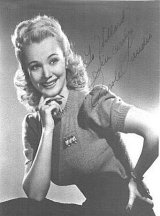 unattractively pointy bosoms of the fifties, and already of the
forties, that made the reputations of the “sweater girls” of the era, leaving
behind Carole, the original “sweater girl,” whose bosom in whatever she wears is
always beautiful. Why turn a woman’s breasts into ice-cream cones? Because the
conic shape is the sign of the breast that cleanly reduces it to its most
general geometrical category, expressible with the fewest parameters (a cone has
no more degrees of freedom than a right triangle). Not even the least attractive
portrait of Carole makes use of this degrading code. But the revenge of the
coders is that Carole’s beauty is perceived in its simplicity as
unnecessarily complex. It is my hope that we have by now progressed enough, in
ways I will attempt later to explain, beyond the Lana Turners and their
successors the Jayne Mansfields to appreciate the beauty that we, and I until so
recently, have nearly but never altogether forgotten.
unattractively pointy bosoms of the fifties, and already of the
forties, that made the reputations of the “sweater girls” of the era, leaving
behind Carole, the original “sweater girl,” whose bosom in whatever she wears is
always beautiful. Why turn a woman’s breasts into ice-cream cones? Because the
conic shape is the sign of the breast that cleanly reduces it to its most
general geometrical category, expressible with the fewest parameters (a cone has
no more degrees of freedom than a right triangle). Not even the least attractive
portrait of Carole makes use of this degrading code. But the revenge of the
coders is that Carole’s beauty is perceived in its simplicity as
unnecessarily complex. It is my hope that we have by now progressed enough, in
ways I will attempt later to explain, beyond the Lana Turners and their
successors the Jayne Mansfields to appreciate the beauty that we, and I until so
recently, have nearly but never altogether forgotten.
To give home and children to a Glamour Girl, it might suffice to follow Carole’s recipe: to be rich, mature, gallant, cultured. Alas, what might suffice for a Glamour Girl like Gaby-Mireille could not be enough for Carole. To cut through appearance to reality is easy enough when you can take off the diamonds and leave a pretty girl underneath, not when the diamonds appear as emanations of the girl’s inner essence. We cannot even say they “adorn” Carole; they do not enhance her beauty, but stand in homage to it, demonstrate the society’s will to honor it. Carole can wear anything from her 1 Million BC cave-girl costume to the lovely yellow dress from Scandal in Paris; nothing in her beauty changes, or is perceived to change. Precisely because beauty is the adequation of appearance to essence, a concrete reality not a sign of something else but of itself, it cannot be cast off like a cloak to reveal some inner Carole who is not yet beautiful. The only way to appreciate Carole’s beauty, to love it, and her “for herself,” is in the manner of those girls sitting on the San Bernardino lawn long ago. But could a man thus enthralled play the role of a husband, in 1941 or ever?
No one, least of all Carole, is impossible to love. But for private love to cope with the public spectacle of beauty would require an extraordinary forbearance. Carole often spoke of leaving the public stage to raise a family; we cannot say this was simply impossible, and had she hung in there a bit longer, her beauty would by maturing have signaled this possibility even without requiring the sacrifice of her career. But as the transcendent Glamour Girl, Carole wanted, needed both intimacy and publicity. Superficial as he may well have been, we cannot refuse to lend credence to Tommy Wallace’s lament that he was “tired of being the husband of Carole Landis.”
The reader might with some justification imagine I see myself in fantasy as transcending this contradiction. Yes, indeed--I transcend it now. I love Carole truly for herself, including in that self every merest detail of outward show. I smilingly indulge her nights at work, even her nights at play. The ruse of reason has conferred on me the immense and awesome privilege of being the biographer, the champion against all odds, of the most beautiful woman in history. But if I fantasize at all about the past, I never see myself as Carole’s husband. I fancy, from what I know about her, that she would have been for me the most loyal of friends, asking only that in return I serve as interlocutor in her loneliness, and answer my telephone that empty, endless night.
5/7/2003
* * *
That Carole needs me is brought home to me nearly every time I leave the protection of her fan club for the mean streets of Hollywood. To express indignation that resentment literature flourishes in the world of the rich and famous is to emulate Claude Rains’ overworked line from Casablanca. Resentment and celebrity go together; there is no other way to deal with celebrities than to resent them, that’s what a celebrity is--and Carole, ahead of her time in so many ways, was an early--the first?--Hollywood celebrity, someone universally known more for herself, and of course for her tremendous efforts during the war, than for her films. But Carole bears a special weight; for those who feast on the splendor and misery of Tinseltown, the combination of extreme beauty and suicide is blood in the water. Poor Carole to have suffered all these years unchampioned.
[in I Wake up Screaming] Carole Landis was as stunning as two Betty Grables. But she’s an actress who’s unremembered. She didn’t have Grable’s warmth, and she wasn’t cunning enough to be a spider lady. There was a coldness about Carole Landis that was almost pathological, as if some essential part of her could never be reached. No matter what role she played, an absence registered on the screen. . . .
Landis’ life and death had all the particles of film noir. The frozen beauty who died for love. . . . Landis was a wild creature. She had anarchy in her blood and in her blond hair, a coolness that was outside any art. She belonged to no particular time or place. She danced with servicemen at the Hollywood Canteen. She sold war bonds in the rain. “You can’t stop a war for the weather!” she admonished a crowd that was fleeing from the rain at a rally on Wall Street. But Carole Landis couldn’t seem to gather much compassion for herself. She rubbed at our own raw nerve, the void that sits right under the American dream. She was a casualty of some secret war--the nightsong that says no, no to fame, money, and success.
She was like that lyrical breakdown the French discovered in the “closed society” of our films. Heartbreak without recompense. Bitterness in black-and-white. (Jerome Charyn, Movieland: Hollywood and the Great American Dream Culture (Putnam, 1989): 139-40)
Beneath the cynical rhetoric--more rhetorical even than cynical, like a parody of a hard-boiled detective novel--there is an insight about Carole and her limited success in film, but resentment has turned analysis to cruel cliché. Just as People magazine’s “curvaceous . . . and unfettered by talent” expresses its idea of a tautology, so is Carole’s “stunning” beauty equated with her coldness--a coldness illustrated by examples of her selfless generosity--and her wild anarchy. This distillation of Hollywood myth demeans Carole and even Hollywood. It has the virtue, however, of its own testimonial status, however degraded--the author’s portrait of Carole, however distorted, is taken from his own experience, which, so far from my own, is nonetheless what the public wants to hear.
I think this nastiness gets me closer to my own truth than easy words of sympathy--not that we should fall into the mimetic trap of preferring hatred to love, however poor in spirit. The only point of view that will encompass both my truth and the world’s is the most radical one, the only one that satisfies me in any case, the one implicit in these raw intuitions: of all the beauties of the screen, Carole alone was truly beautiful. No other actress has been called beautiful so often, so insistently. This is not new. Yet when the public hears of her at all, even on the carolelandis.net website, it is as one of a procession of Babylon Women whose lives were ruined and often drastically shortened by the studio system, the “selling of human flesh,” Carole being at best an exemplar of these shattered starlets. At least Charyn has the good taste, if that is the word, to speak of Carole apart.
Hollywood sells the signs of beauty, and Carole was the real thing. I knew it instantly when I first saw her on the screen: here was what all these so-called beautiful women, these pretty glamour girls in the soft backlighting, were pretending to be. It is not only my heart that is touched by Carole; and I do not speak for the moment of her “love, graciousness and kindness.” Whatever I am, and whatever my strange and, why not, wild care for Carole says of me, I see her with the eyes of any man--or any woman, for women react to her the same way. This is beauty; and why with such surprise? What else is our dream factory supposed to be producing? Why must the signs of beauty be cut off from its reality? And why has no one noticed until now?
I have said this already in a number of variations, but never as forcefully as it needs to be said. Culture is about signs, not realities, about realities, so long as they point to something other than themselves. It is easy to see that when we talk about food, we aren’t eating it. But poems and stories are rarely about food. We have come a long way from Lascaux and Altamira; the Neolithic revolution spelled the beginning of the end of animal stories, but surely not yet the beginning of love stories.
We read of beauty and our imagination fills with an absent image. Whatever beautiful women we have known, our memory traces are never enough to satisfy the words of the story. And so it has been with cinema, the “beautiful” actress a stand-in for desire’s transcendence of the everyday--for desire is only for the sacred. Yet somehow Carole made it to the screen, held on to a modicum of stardom through 28 films. One could not call it a mistake, a misunderstanding, perhaps? Or was curvaceous Carole supposed to be not beautiful but sexy, adding a touch of pornography to the screen? Yet never was the sexually desirable more chastely portrayed--the coldness, no doubt, our author feels and knows not where to place.
Let Carole have her tragedy; tragedy is not the serial sobbing of soap opera.
If there is absence on the screen in her presence, it is the absence of what her presence was to absent itself for. We cannot bear such beauty in a fiction.
Had Charyn seen the movie he was watching, his analysis would have agreed with
mine: Carole is the sublime heroine of I wake up screaming, too beautiful
to live yet too beautiful to ever leave the screen, she haunts it indeed as a
ghost of unrequited grace. The showing of her cut-off song on film within
the film reminded me of a scene perhaps more powerful, for central to the plot,
in Genini’s Prix de beauté--whatever they say of the Germans, Louise
Brooks’ greatest role--and here was a true beauty, no rival to Carole, a gamine
of the twenties just unwomanlike enough to leave us free to dream and then to
catch our dream in the intelligence of her eyes, one whose career likewise came
to grief, but who less tender lived on till resurrection--prizewinner Louise is
stabbed watching her own filmed triumph that plays on into the night of death;
the contrast of dead and living body both the same an allegory of the danger of
signification.
her presence was to absent itself for. We cannot bear such beauty in a fiction.
Had Charyn seen the movie he was watching, his analysis would have agreed with
mine: Carole is the sublime heroine of I wake up screaming, too beautiful
to live yet too beautiful to ever leave the screen, she haunts it indeed as a
ghost of unrequited grace. The showing of her cut-off song on film within
the film reminded me of a scene perhaps more powerful, for central to the plot,
in Genini’s Prix de beauté--whatever they say of the Germans, Louise
Brooks’ greatest role--and here was a true beauty, no rival to Carole, a gamine
of the twenties just unwomanlike enough to leave us free to dream and then to
catch our dream in the intelligence of her eyes, one whose career likewise came
to grief, but who less tender lived on till resurrection--prizewinner Louise is
stabbed watching her own filmed triumph that plays on into the night of death;
the contrast of dead and living body both the same an allegory of the danger of
signification.
I would never have let it happen, yet accept poor Carole’s death to make her immortal. She left herself open to absurd accusations less calumnious than incredulous; no one could comprehend that in the world of tinsel she was just what she was, a sign pointing not to the empty space of desire, but to transcendence and herself, the two ingredients of sacred signification. You have waited all this time, Carole, for someone wild enough to understand you.
5/8/2003
Here, from Charyn’s unnamed source, the New York Times of June 5, 1944--the day before D-Day!--is Carole the ice-queen, selling bonds in the rain:
Former Governor Alfred E. smith’s three-day campaign to enlist the 20,000 [war bond] salesmen moved yesterday into the financial district, where Carole Landis, movie star, addressed a crowd of several hundred who braved cold rain to hear and see her.
“You can’t stop a war for the weather. The boys over there don’t,” said Miss Landis, one of a group of film stars who entertained service men in Africa, England and Ireland from October, 1942, to March, 1943.
“If every person in Manhattan could spend one hour at the scene of actual fighting, Al Smith would have 20,000 bond salesmen applying every hour,” she said.
Before passing out the pledge cards, Miss Landis, standing under a dripping umbrella, sang the “Oklahoma” hit, “Oh What a Beautiful Morning.” She arrived at the Subtreasury Building in one of six jeeps in which rode Wacs from Second Service Command headquarters.
The first volunteers to present themselves in response to Miss Landis’ appeal were Harriet Hogan of 150 Jericho Turnpike, Floral Park, L.I., and Elizabeth Sciotino, 1650 East Thirty-third Street, Brooklyn.
Frozen film-noir stuff, isn’t it? Imagine using your beauty and glamour, and the credibility gained through hundreds of performances at home and abroad, to sell bonds in support of a war against Hitler. What matter if the tough-minded rhetoric: “she admonished a crowd that was fleeing from the rain at a rally on Wall Street” directly contradicts its source: “Carole Landis, movie star, addressed a crowd of several hundred who braved cold rain to hear and see her.” The crowd loved Carole, and she loved them, just as she shared the love of those servicemen she danced with. Only Hollywood, that attracts so much stray love, can generate enough resentment to turn human warmth that braves cold rain into the stuff of chill and horror. "Heartbreak without recompense" is a fine description of Charyn's epitaph for Carole; I hope his own will commemorate his "love, graciousness and kindness."
5/9/2003
Yesterday I wrote to the LA Times requesting approval in principle of an Op-Ed piece on Carole to appear July 4 (July 5 falling on Saturday). This morning I received a one-line answer: “What is the argument of your piece?” Now I await the effect of my reply, which emphasized Carole’s war effort and, at Stacey’s suggestion, the sexism with which she is still treated (curvaceous and unfettered by talent; coldness that is pathological). There is a question about how I would like her to be remembered. I was not altogether facetious in telling Bill I’d like to get her on a postage stamp: Carole is someone that must be remembered in and for herself rather than as a participant in major works of art. Whether or not we worship Humphrey Bogart, we will watch The Maltese Falcon no matter what, and will retain him in memory whether we want to or not. In Carole’s case, with a couple of minor exceptions--her pictures where she plays sister to Betty Grable, perhaps Scandal in Paris--we will watch her pictures only because we want to see her. But to remember Carole as someone important for something other than her films is to emphasize her wartime goodness, write for her what Bill calls jokingly a hagiography. Or perhaps not so jokingly.
I also made my Tuesday appointment at the Academy, where I’ll try to find some leads to approach Carole’s family. I also need to get my hands on some old screen magazines; perhaps through interlibrary loan.
Too tired to have any new insights; I’ll continue this tomorrow. I should also add some pictures to this file.
5/10/2003
Reading passages of this “diary” to correct and marginally improve the text, some appear powerful or at least interesting, many banal and repetitive. Is this my book on Carole, the book on which we both lay our chances of salvation? If so, I wonder if the game is not already lost. (A counter-productive meta-text, certainly.) To multiply her fame by mine would diminish it. If there is not enough story in her films to make her the usual expanded footnote to them, then her story must be told here, and if there is not enough in her story alone, then it will be mine as well, my encounter with Carole as a source of eternal youth--eternal in the only valid sense, which is as an allegory of the transcendence first realized when the place of desire was named by the name of God.
Even to look at her photographs, or to want to look at them, requires a book that will define her as someone to be looked at. One must speak of her beauty, but not only of her beauty, and somehow not just “not only”: her beauty must be her story, must be made a legitimate theme of a story. And all this depends on me.
All my other writings will “survive” as all writings survive nowadays, in the bowels of some library, real or virtual, to be exhumed perhaps never, perhaps… there is no opposite of “never,” since we have no idea of the human time of the future; we can imagine “never,” although it can never be absolutely guaranteed before the end of human time; we cannot imagine its opposite, not without concentrating on a specific time, however abstractly rendered. But this book must survive in a different sense; it must first live, not as the others vegetate. Whence acquire this gift of life? From Carole herself, were it possible…
 Today we
bought some 11x14 frames for two copies of Carole’s famous Chesterfield ad, that
shows her, described as “back from the war zone,” in a blue WAC (?) uniform, her
face simplified for the print but wearing thick blond hair and a lovely smile. I
will find a place to hang one of them in the study, the other in the office,
this being a lighter version of Carole’s beauty than would appear in a real
photograph. I placed bids on several Photoplay issues, and am looking at a
number of other items. But not seeing Carole on screen makes me feel that
despite these gestures I am losing ground; what have I learned about her during
the last week or two? I looked through the screen magazine collection at the
Library of Congress; they have almost all of them; I’ll have to ask how to
access the articles without traveling all the way across the country.
Today we
bought some 11x14 frames for two copies of Carole’s famous Chesterfield ad, that
shows her, described as “back from the war zone,” in a blue WAC (?) uniform, her
face simplified for the print but wearing thick blond hair and a lovely smile. I
will find a place to hang one of them in the study, the other in the office,
this being a lighter version of Carole’s beauty than would appear in a real
photograph. I placed bids on several Photoplay issues, and am looking at a
number of other items. But not seeing Carole on screen makes me feel that
despite these gestures I am losing ground; what have I learned about her during
the last week or two? I looked through the screen magazine collection at the
Library of Congress; they have almost all of them; I’ll have to ask how to
access the articles without traveling all the way across the country.
Is a daily record a plan? I will continue to write daily, and from commitment alone if nothing else I will derive the force to see this through.
Beauty, after all, Carole’s more than anyone’s, is taking risks; her large, open features never hold themselves back. In life too Carole kept no reserve; in the end no more than all her life she sacrificed life for beauty. Can I tell her story in chronological order? Isn’t that more order than she found?
Who am I to right the wrongs of history? But if Carole has no one else?
5/11/2003
Today I made contact with Jeff B., who has a number of Carole films available; there must be a few dozen Carole fans out there, with various kinds of information, if I could get hold of them. Whatever theories one wants to spin, Carole is just too beautiful not to attract some attention. Let's hope some of them are more communicative than Frank S.
 We also hung up a
few pictures on the wall of my study, which has become something of a Carole
museum, not to say shrine. Carole's image reassures me that there are things in
time that transcend time. I was reading a paper that referred to Roland Barthes'
ideas on photography, with his gimmicky opposition between studium and
punctum, the subject of the picture and the petit fait vrai that
presumably grabs you because it is not predictable from the lesson the picture
is supposed to convey. I find this kind of pan-estheticism drearily
narcissistic. Do we have time to follow the meanderings of so-and-so's brain to
discover the interest of an image, when I can show you the most beautiful woman
ever photographed? And all that facile idea-play between photography and death,
all in the service of filial piety, of course. Haven't we yet done with the
"intellectual" and his phenomenological pontifications, fitting our experience
into his mold, the heirs of Victor Hugo. It is no accident that the intellectual
sees death everywhere; when does he see beauty? At best some tiny point of
interest, what Collins calls a "small," distracts our attention an instant from
our deathly meditation, plunges us, but only for a second, into timeless
depth--then quickly out again, lest the reader become restless before the
writer. Carole reposes me, even from the resentment of that other self that sees
the sublime in smallness and the beautiful not at all. If the beautiful is
defunct, then I am already with the shades cavorting in the Elysian fields. Or
perhaps I am too impatient with those who fear above all loss of community,
thinkers at the Sad Café clinking their glasses with understated jollity,
worshipers of momentarily straightened intricacy, not baldfaced admirers of
beauty.
We also hung up a
few pictures on the wall of my study, which has become something of a Carole
museum, not to say shrine. Carole's image reassures me that there are things in
time that transcend time. I was reading a paper that referred to Roland Barthes'
ideas on photography, with his gimmicky opposition between studium and
punctum, the subject of the picture and the petit fait vrai that
presumably grabs you because it is not predictable from the lesson the picture
is supposed to convey. I find this kind of pan-estheticism drearily
narcissistic. Do we have time to follow the meanderings of so-and-so's brain to
discover the interest of an image, when I can show you the most beautiful woman
ever photographed? And all that facile idea-play between photography and death,
all in the service of filial piety, of course. Haven't we yet done with the
"intellectual" and his phenomenological pontifications, fitting our experience
into his mold, the heirs of Victor Hugo. It is no accident that the intellectual
sees death everywhere; when does he see beauty? At best some tiny point of
interest, what Collins calls a "small," distracts our attention an instant from
our deathly meditation, plunges us, but only for a second, into timeless
depth--then quickly out again, lest the reader become restless before the
writer. Carole reposes me, even from the resentment of that other self that sees
the sublime in smallness and the beautiful not at all. If the beautiful is
defunct, then I am already with the shades cavorting in the Elysian fields. Or
perhaps I am too impatient with those who fear above all loss of community,
thinkers at the Sad Café clinking their glasses with understated jollity,
worshipers of momentarily straightened intricacy, not baldfaced admirers of
beauty.
Now there is a photograph on the introductory page of this site of me in my study with seven pictures of Carole. It's not as pretty as a picture of Carole alone, but it expresses my dedication to this task, without which Carole's face will remain known to but a few. As for thinking myself unworthy or simply unable to perform this task, such thoughts are themselves unworthy of Carole. This is not some postmodern mimetic game; I do not invent Carole--she is, and as what she is, she needs only to be shown to be recognized.
I must make an effort to see Carole's remaining films; tomorrow I will inquire about those in the film archives at UCLA. I am anxious to gather all possible information, and what I am discovering is that this is a slow process, involving leads to be followed up, dead ends, like a police investigation. It is the first and only time that I must track down the traces of a human life, one that did not exhaust its value for the world in those institutional creations generally called its "works." The term "biography" covers over the problematic nature of such a task, as though there were some self-evident formula for "writing a life." It is not that human life is too "natural" to be enclosed within the fabric of culture; it is rather that what in a life can and will be passed on in legacy to civilization cannot be defined in advance. To the extent Carole or anyone makes a contribution to history, it changes its form as well as its content, and cannot therefore be described by filling in the blanks. Life is lived chronologically, and we must respect its intentionality; but death transfigures life, and we must in a life like Carole's rewrite her life's intentions to reveal the more significant meaning of her actions; often the horizon changes, and what was done for a long-term purpose becomes of interest as the fulfillment of an immediate goal. Carole in a near-bit part in Moon over Miami, dutifully playing her role onscreen, is meaningful not for what she does but for the potential she renounces, the latent power of her beauty, so dazzling in color. We watch her for a minute, and we can put up with an hour of Betty Grable. We cannot stop or even slow the film to look at Carole; we must pass over her to the next scene, but the cry of what we missed resounds in us longer, forever, than the saturated harmonies of the story.
This is a time when I wish I believed in the afterlife. No, Carole is not smiling down on me from somewhere. Let others smile at the sight of Carole, and I will be content.
5/12/2003
Today I heard from "twilyipop," the winner of the record Carole made a few days before her death (unless of course it's a different one). This gentleman is a great fan of Carole, even considers himself her reincarnation (!), and kindly offered to send me a copy of the record. There are Carole fans out there; it suffices to be patient and to find the right places to contact. It would be especially good to find some relatives of Carole's; this shouldn't be terribly hard. There are a couple of Dorothy Ross's in Long Beach and a couple of Ridstes in California who may well be related to her. This isn't my usual MO, but that makes it all the more serious: these are real people, Carole is a real person, whose reputation has been besmirched and whose achievements have been neglected. The LA Times sent me a boilerplate rejection of my "submission" when I hadn't submitted more than a brief statement; not very polite, but it does point up the key problem: how to sell Carole to the unknowing public.
What is unique about Carole is her beauty. Her goodness and generosity were exemplary, but you can't expect to attract interest to someone just because she was good and generous. Yet once you define her by her beauty, you seem to be reducing her to her physical attributes. How do you go about telling people to remember someone? One has to make some victimary claim: this person has been unjustly forgotten; either his achievements are worthy of note in themselves but history has neglected them, in which case we are setting the record straight, or this person's achievements have been recognized but their importance underestimated, in which case--much the more difficult--one must promote a reevaluation based on new, or more universal criteria. The enterprise by its very nature arouses skepticism: if I haven't heard of this person, how much can he amount to? if nearly all Carole's films are pretty much forgettable, can we speak of her filmic accomplishments? there is an argument to be made concerning her beauty and its relation to film and popular culture, but that argument cannot be summarized in a paragraph without seeming to beg the question: Carole was too beautiful to be in film, or so beautiful that even a brief appearance is worth waiting an hour for.
Even if I find all her relatives and fans, and amass a maximal knowledge of her life, this does not solve the problem of revealing Carole to those who are not already predisposed to her. This revelation can only be made through visual means. One has to see Carole to understand what all the hyperbole is about. But to depend on sight is to forego explanation. And if someone says, "Yes, she is very beautiful. So what?" how do I persuade him to give higher value to his intuition of beauty?
In any case, I will be getting four films from Jeff B., and have arranged to watch three more at UCLA; if I ever get those I ordered from my Canadian friend, I will have seen just about all her films. If I can get hold of the magazine articles about her, I will have pretty much exhausted the documentation, absent the relative with private collection. At that point I will have to deal with the question I've been turning over: what kind of book to write? How much strategy do I need to use in presenting Carole?
Carole's beauty restores my faith in the harmony between desire and reality. Yet there must be something more specific that I have not yet grasped. What is it that makes me so attuned, in the literal sense, to her beauty, as though it were the guarantee of some ancestral home? One would expect me to think this way about a brunette. (Not that Carole's blondness was entirely a natural feature.) When, or if, I find the answer to that question, I have the impression that I will also find how to structure the book. Beauty as generosity, as a universal expression of love. To accept to be beautiful, to be the transcendence of everyone's desire. Carole's beauty is the beauty of acceptance. Even in the portrait that registers her ambivalence between presence and absence, there is no reticence about showing herself, no forwardness either, simple confidence. But Carole's confidence, although it begins no doubt with confidence in her own beauty and its ability to attract desire and transcend it in awe, is projected from her pictures rather as a confidence in us. Carole is confident we will find her beautiful, but what she says to us goes beyond this binary circulation: that we will find in her beauty a gift of love that we will share with her and with each other. This requires no more than a glance to appreciate; but we must make sure the glance is cast. I will need a book jacket and plenty of illustrations, as well as some hope that sentiments of love are as contagious as those of hate.
5/13/2003
I spent the afternoon at the Academy library, but that will have to wait until tomorrow. The following is my brief to Nick Goldberg, Op-Ed editor of the LA Times, for including an article about Carole in the July 4 issue (the 55th anniversary of her death). Is it convincing?
| Dear Nick,
Thanks for giving me a chance to make my point clearer. As the author of many pages of abstract theorizing, I feel ashamed not to have presented my case in more intellectually compelling terms. Carole Landis occupies a unique place in what might be called the history of public beauty, involving not just the mass media but the entire Hollywood publicity enterprise: dress, makeup, glamour photography, etc. She is the one actress that is *always* described as beautiful, or at the very least as "curvaceous," "distractingly desirable" (LIFE), etc. This reflects the harmony of face and body that puts her in a class by herself, but it also reflects a particular historical moment, between the theatricality of the thirties and the teasing of the fifties, when it was possible for a desirable woman to present herself as such without pointing to her desirability, whether by flaunting it or coyly appearing to deny it. This was the moment when American popular culture came of age--and when Hollywood produced its greatest films: Gone with the Wind, Citizen Kane, The Maltese Falcon, Casablanca... As a rule, our "beautiful" actresses fuel our imagination by giving us the *signs* of beauty, not beauty itself. The forties offered a unique window of opportunity for a woman as beautiful as Carole to become a public figure. But Carole was nonetheless too beautiful to star in "major" films. You look at her and forget the plot. I wake up screaming, her most interesting film, has Betty Grable (a good example of a "beautiful" actress) investigating Carole's murder; flashbacks, photos, and even a movie clip of Carole dominate the film (the police detective is revealed as having a shrine to her in his living room), but, precisely, she is dead from the beginning; the world wants to know who banished beauty from it, and the answer is everyone, the murderer being the most anonymous character in the film. Carole was talented enough to maintain her career until the war. There she found a true outlet for what, in Hollywood, had always been problematic: her hundreds of USO performances here and abroad, more than any other entertainer, were a gift of her beauty to the GIs. (Carole had a lovely contralto singing voice, in fact, dubbed singing for other stars.) There is a letter by a witness to one of the USO trips who noted that whereas the other entertainers (Jack Benny et al) just waved to the boys in the field hospital, Carole not only took the trouble to speak to each one individually, but also came back alone the next day for those she had missed. No one was more beloved of the Allied soldiers in WWII. Carole wrote a popular book about her first USO trip, entitled 4 Jills in a Jeep, which demonstrates a writing talent extraordinary in someone who never finished high school; this was clearly the high point of her life. After the war, although Carole continued doing charity work of all kinds, the world was moving in the direction of the fifties, and the climate of adult, understated sexuality in which she flourished was losing ground to adolescent excesses. (Compare Carole's chaste "cheesecake" photos with Marilyn's famous nude calendar, or Jane Russell's ironic sluttishness.) Whence the fits of depression that culminated in her suicide. I am devoting my time to this book about Carole Landis, wholly unlike the books on anthropological theory and French literature I have written until now, because I feel she is a national treasure whose memory should be cherished. Carole is unmistakably American. What makes her beauty unique is its generosity; she turns the Hollywood publicity machine that makes her accessible to the general public into a means of making a gift to others. There is an unreserved radiance in her smile that has never been seen before, and that we will never see again, because the glamour of Hollywood no longer has its star-system sacredness to protect it from vulgar oneupmanship and the banality of sex. If you're still reading this, I invite you to take a look at the web essay that was my initial reaction to Carole at http://www.anthropoetics.ucla.edu/views/vw280.htm . It contains most of the arguments I will use in the piece I am proposing. It would be a terrible waste to let slip away the memory of the one person the mere sight of whom makes life more worth living. We speak of the people of the forties as the "great generation"; Carole's extraordinary beauty is a fitting symbol of that era. (If people need convincing, a photograph or two should do the trick.) There are still many old GIs out there who remember Carole and who will appreciate this gesture, maybe even write some nice letters to the Times... Thanks for reading this, eric gans |
5/14/2003
It seems I am amassing much more information about Carole than I can process in these entries, to which I will have to devote time more systematically.
Yesterday, I spent the afternoon at the Academy library, where I went through all Carole's photos, including some new ones, copied the names of all her family members, made copies of the articles in Photoplay--the only magazine on microfilm. Some of these articles are very touching. Carole writes about her love affairs and marriages with what seems to be utter frankness--even if these articles are composed in the first person from notes rather than written by Carole herself. This phenomenon of unvarnished sincerity that finds itself nonetheless on the market is surely new in this period; but my intuition tells me that Carole was more open about herself than anyone else. There is a total honesty about her character that seems completely unaffected by her public role, although of course her love experiences themselves are not. This very combination of unguarded frankness and public life, which Carole seems to live unproblematically, explains her discomfiture in love relations, where intimacy requires shielding one's self from the outside world. Carole's analysis of the failure of her marriage to Tommy Wallace is heart-rending; it is impossible to imagine a media figure expressing such direct sincerity today.
Today I watched the film The Powers Girl at the UCLA media lab; the first new Carole film I had seen in some time. It was an interesting experience that convinces me that Carole's story is in the interface between her life and the myths created around it, in the first place by these films.
Interesting does not mean either pleasant or distinguished. The Powers Girl has some of the dumbest and most heavy-handed comic routines I have ever seen. The most egregious of these has to be seen to be believed: the hero, a photographer played by George Murphy, about to join the army in his coveted position in the Signal Corps, has been made jealous by his girl, who pretends to be about to marry another man. GM picks a fight with the other gentleman; they go off to the bathroom to fight; meanwhile, the squeaky tenor Dennis Day of the Jack Benny show, in a rare film appearance, gets the orchestra to play Auld Lang Syne in honor of GM, but the music stops when the latter is seen exiting the room. In the bathroom, the fake Other Man slugs Murphy, who falls into a gentleman shaving himself with a straight razor, slicing off a piece of his face. Seeing this sequence once is already an insult to one's intelligence--it is repeated in full THREE TIMES! And there are many other lesser moments of agony.
The film is nonetheless interesting for its development of the Carole myth. Although she is third billed, Carole is the dominant female character, eclipsing her sweet blond rival--once again, her sister--played by Ann Shirley, who looks like a younger, sweeter version of Ann Sothern. Unlike her structurally similar role in Scandal in Paris, this one gives little play to Carole's charm or even her beauty. The film is a degraded continuation of I wake up screaming. It begins when AS, a schoolteacher in a Small Town, slips in a rainstorm and is carried through a puddle by the town drunk, a mishap serendipitously photographed by Murphy and published on the front page of a fictional New York based periodical whose name I cannot recall. As a result, poor AS is fired by the strait-laced school board; jobless, she makes her way to NYC where sister Carole is making a living as a salesgirl in a bargain basement--an even less glamorous clone of Carole-Vicki's hashslinging job in I wake up--but dreams of becoming a model. Because her sister's picture in the magazine was not authorized, and because her job was lost, Carole goes to the magazine office to seek compensation, and runs into Murphy, who pretends to be the firm's Vice-President and after various silly complications takes Carole to lunch, where she tells him that her great dream in life is to become a model. Well! Murphy exclaims, John Powers, the head of the famous model agency, is a great friend of his. Of course we know this can't be true, but Carole falls for it, and on returning home, Carole gets her sister to sign the release for the photograph, pleading that she has been working so hard for so long to be a success, and that the chance to become a model is something she just can't pass up. Through some more silly maneuvering, Murphy takes Carole to Powers' office and gets in to see Powers by pretending to be an air-raid warden--the first plot-element that hinges on the egalitarianism brought about by the war. In order to get rid of Carole, he tells Powers in private that Carole is his fiancee and that if Powers can rid her of her delusion of becoming a model, they will be able to get married and return to the Small Town whence they came. Powers agrees; Carole is let in; but as soon as he sees her, Powers recognizes her modeling potential and signs her up for model training. This sequence eventually results in Carole's triumph: in a scene reminiscent of dozens of musical comedies, a group of presumably real "Powers girls" come on stage, followed by some rather insipid dancing, followed by... Carole, the number 1 Powers Girl of 1943. This professional triumph is, however, followed by personal discomfiture. Driven by mimetic desire, no other reason being apparent, Carole decides that sister Shirley's GM should be in love with her, and partially succeeds in her efforts, when the jealousy maneuver mentioned above, which involves our Main Street girl's rental of furs, gems, and fancy dress, leads to an the revelation that G still loves A. We cut to the outside of what looks more like an office building and a church; GM and AS have just been united in lawful matrimony, but he can't stay for their honeymoon. The film thus ends on what would sound pretentious to call a note of irony. [to be continued]
I'll return to film analysis shortly; first, a copy of an email sent to someone who must be Carole's nephew:
Dear Mr. Ridste,
Please accept my apology if I am in error, but I assume you must be the nephew of Carole Landis, née Frances Ridste.
As you must know, there has never been a book written about Carole Landis, and much of what is in print about her is false or distorted. The saddest thing is that most people, including even those in the film business, have never heard of her. I hope to rectify this situation. I am working on a book that will emphasize her accomplishments and her real importance rather than concentrate on her unfortunate suicide.
Carole Landis deserves to be remembered, among other things, for her generosity and kindness to the GIs in WWII--at great sacrifice to her health and Hollywood career. I have read some very moving material on this subject.
Since this is likely to be the only book for a while about Carole Landis, I am anxious to contact her family, both to make you aware of my project and to tell her story as completely as possible. I would be especially grateful for the opportunity to meet with any family members in Southern California.
I am 61 and have taught at UCLA since 1969. I teach French film, but this project is a personal one. I was too young to remember your aunt from my childhood, and her name was only vaguely familiar to me. A few months ago I saw her in a film on TV and was struck by her extraordinary beauty--a beauty of soul as well as body. Everything I have learned about her since has only reinforced this impression.
If you are at all curious about my project, please have a look at
http://www.anthropoetics.ucla.edu/cl/caroleproject.htm
My own cv is at
http://www.french.ucla.edu/faculty/gans/index.html
Please forgive me for this intrusion. I hope you will be willing to help me, but I can well understand that you might not be interested, in which case I won't bother you any further. I do want you to know that my sole purpose in this undertaking is to honor someone who was, I am sure, a very dear member of your family.
Sincerely,
Eric Gans
How about this one? Will Mr Ridste, who is probably a little older than I, respond favorably, or respond at all? La suite au prochain numéro.
5/15/2003
This morning I was very happy to receive a response from Bryan Ridste who mentioned he would pass my message on to his sister, and presumably get me in touch with other family members. This marks a turning point of sorts in this project, which until now could be considered that between a living person and an image. I think it is a justified transition because all my efforts have gone toward making Carole a real person rather than a ghost. Meeting and dealing with her family, persons she herself knew and loved, and who loved her as their own flesh and blood, is the most human guarantee conceivable of the human truth of this project--of my sense of Carole as a real person rather than the object, however favored, of a subjective fantasy, even one designed to counter the malevolent fantasies that have largely taken the place of real knowledge of this person.
I hope I will be able to meet some of these people, particularly Carole's favorite niece Diane Carole, who must have very fond memories of her aunt.
* * *
To continue my analysis of The Powers Girl: here we see beautiful Carole transformed into the same grasping figure as in I wake up..., but the resentment against her, instead of discharging itself in her murder and consequently permitting her so to speak to reemerge as herself in the flashbacks to quite striking effect, remains alive in the film as a malevolent force, degrading and caricaturing Carole's personal quest to "become somebody." Everything from makeup to camera angle to hairdos, the crowning one of which is the ugliest I've seen Carole wear--pushed out around the sides and flattened on the top, capped with a bejeweled ornament, then curled back all around her face like a picture frame--is geared to making Carole look hard and heartless, and far less beautiful than she should be. Fortunately there is always her beautiful body; nothing much could be done with that, or rather, its display as purportedly in contrast with her mask-like face is meant to stand for the opposition between body and soul, in contrast with the harmony of her sweet sister. Carole's modeling success is, of course, due to this body, and there is even a hint of less admissible forms of its commercialization in one put-down, addressed to AS by GM's mother, "You're the type men look up to, she's the type men look up." Not something very nice to say about someone's sister, but by this time family ties are no longer relevant, and indeed, at the happy couple's wedding, so ironically reminiscent of Carole's own just a year later, the evil Powers Girl is no longer to be found. The sacrificial expulsion of beauty degenerates into ugliness in this film because, unlike I wake up, it lacks aesthetic awareness of its sacrificial structure. No doubt this awareness is incomplete--and it is an illusion to suppose that even Christianity, as Girard would have it, expresses the ultimate truth of this or any structure of human interaction--but it is a giant step closer to tragedy. Simply the preservation of beauty in the context of its denial, a realization of the possibility inherent in "mechanical reproduction" itself to outlast its real-life sources, makes it an aesthetically far more successful enterprise: the photograph, the "dead" image, here survives to fill the screen with its light. At the end when poor Laird Cregar takes poison before his collection of Carole portraits (an act I am not tempted to imitate, never having suffered the pain of Carole-Vicki's transition from life to afterlife, although contact with Carole's family will no doubt bring me closer to such mourning), Carole's lovely image is not so much exorcized as purged of any sinister qualities. We already see this in the final flashback in which Carole-Vicki herself appears, where the writer is shown climbing in the window of her apartment through the fire escape to let her in, she having mislaid her key. Nowhere else in the film is she lovelier, and warmer in thanking her gallant friend and admirer, and he swears to send her flowers and posthumously keeps his promise.
How much more profound at its core is this underrated film than its near-contemporary Laura, enhanced by what must have been a far greater budget, bigger stars, superior direction and "production values," where a similar ghostly image reveals itself by a detective-story trick to portray a living woman. Gene Tierney, lovely as she is, did well to survive in Laura the pale attractions of her image--a painting, we note, rather than a photograph, for on this plane there could be no competition; only the most beautiful woman ever photographed could dramatize beauty's survival in a snapshot.
* * *
I learned from a new Internet contact that another person claims to be writing a book about Carole Landis: the author of an earlier book entitled Hollywood Death and Scandal Sites : Sixteen Driving Tours with Directions and the Full Story, from Tallulah Bankhead to River Phoenix. A fitting personage to write about Carole, although one wonders why he would devote a whole book to the subject; are there a book's worth of scandals in Carole's life? Would the appearance of such a book benefit or hinder my own project? I cannot waste my concern on such issues. I just must continue to acquire new information and think about how to package it. Of course appearing in the LA Times would help, but I certainly can't count on this.
But there are Carole fans out there, no doubt, from the small sample I have encountered, mostly men who are struck, as I am, by her beauty. My new acquaintance agreed that the photograph I singled out for comment--it is something of a miracle that I purchased the last one commercially available, that there are no plans to print others, and that it is not among the photographs of Carole on eBay, in stores, or in the considerable collection of the Academy. Why not print up a few more copies of the most beautiful photograph ever taken? No doubt for the same reason that writers call Carole as a "bouncy sexpot" and much worse: beauty is sacred and the sacred provokes resentment in those who are unwilling to pay it homage.
5/16/2003
Nothing more from either the Times or the family for the moment. I obtained It happened in Flatbush from eBay; with the four films I am expecting from Jeff B. (the two westerns, My Gal Sal, and It Shouldn't Happen to a Dog), and the two I have arranged to see at the film archive in Hollywood, that leaves only two remaining: A Gentleman at Heart and Turnabout, both of which are at UCLA if I can't get them otherwise. I imagine that with a little patience I will be able to get all but one or two of Carole's films, and will be able to watch them all. The bit parts are another story, but many of them are in films readily available (A Star is Born, A Day at the Races, Gold-Diggers of 1938, etc.). As I learned from The Powers Girl, mediocre as it certainly is, Carole's filmography is not precisely biographical but it plays off Carole's own life, distorting different aspects of it into legend. Filling in the gaps will surely provide further insights.
Tonight we watched Entertaining the Troops, a PBS compilation, produced in 1989, of footage from WWII, followed by a lengthy and rather tedious interview/reminiscence of Bob Hope and the entertainers who accompanied him to the South Pacific and various other parts of the world. Whatever else one can say about Hope, he certainly gave generously of his time and energy to the armed forces. Unfortunately, the two women who accompanied him, principally the singer Frances Langford, are not much to look at, although they were surely a feast to the GIs.
Just midway through the film, after what appear to be glimpses of her in one or two other scenes, notably at the Hollywood Canteen where she was known to dance with the soldiers, Carole sings a number, "Pin-Up Girl" that is, I think quite objectively, the high point of the show, both for its inherent charm and its spirited execution. No one seeing this little performance could have the least doubt about Carole's talent not merely for singing, but for putting over a song. Even on a stage far from her audience she makes more personal contact with her audience than anyone else in the film.
In this charming number, Carole teases the audience by hiding at first behind a cut-out of an immense female body, promising to show herself in a bathing suit, then stepping out in a turn-of-the-century bathing costume. She changes costumes another three times during the performance, emerging each time from behind the cutout. Throughout she is playfully seductive, always in complicity with her audience, so different from the little-girl teasing of Marilyn Monroe in the following generation. At one point she strikes her most seductive pose, lying on a table and bending her head back toward the audience (revealing really rather little, as is always the case), saying "I'll keep wearing less and less / If that can give you happiness." Carole didn't write these words, but they humorously express her relationship to the whole enterprise of war entertainment: giving her beauty to keep the boys happy. Although, mostly through the ultimately irritating intermediary of Bob Hope, the desirability of even not-very-desirable women like Frances Langford is thematized for the soldier audience, Carole is the only performer to refer to her own pin-up-girl status, with a cheerfully ironic confidence that the men do indeed want to see her in a bathing suit. Once more immense sadness that this beautiful and wholly lovable woman is all but forgotten. One cannot criticize the creators of the film that they never speak of her outside her performance and one other brief appearance with Jack Benny; les absents ont toujours tort. Ironically enough, this virtually uncredited film contains one of Carole's very few complete performances and perhaps her most successful--less elaborate than the flame song in Scandal in Paris, it is a much better musical number and, unlike the later performance in a somewhat unnatural role, put over with total control and ease.
Just before Carole sings, Dorothy Lamour, who handles a bit of the narration, talks about the favorite pin-ups of the war; we see the famous rear shot of Betty Grable, a much nicer picture of Rita Hayworth, who, unlike Grable, could truly be called beautiful, if far from Carole's one-player league, and a shot of Lamour herself, in the South Seas mode she used to such effect in the "road" movies with Crosby and Hope. Lamour is no doubt correct that those three were the favorite pin-ups of the war. But as in so many cases I have already seen in my still-incomplete journey through Carole's films, fiction is truer than truth: it is Carole, who unlike Betty is beautiful and unlike Rita can sing, who is the living incarnation of the pin-up girl. We should be thankful that at least these few minutes of Carole's performance have not been lost; like so much else, the experience is a painful reminder of the terrible waste of memory she has suffered, yet this little gem recovered from the debris of her career tells us all we need to know about her entertainment abilities . Once more the special nature of my task is set in relief: in a media-saturated world that defines celebrity as being available to it in more performances than one could see or could possibly want to see, to treat a media figure as something like a wonder of the ancient past, available only through suggestive fragments extracted from the ruins of a dead world. We cannot fill the empty space by playing this little song over and over--we watched it a second time after completing the film, as we watched Carole's number in 4 Jills--but, once having heard it, we should let vibrate in our memory this joyful moment that leaves us all the more regretful of its creator's untimely end, then quietly and painfully appreciative that there has passed among us someone so unbearably lovely.
5/17/2003
Today I received, along with an issue of Photoplay, three postcard-size
pictures of Carole, two very beautiful cabaret-like shots that must be later
than 1941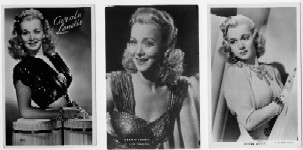 and one less so
in the dress of the most popular autograph.
and one less so
in the dress of the most popular autograph.
5/18/2003
Nulla dies sine linea; yesterday I spent too much time correcting past entries and became too tired to think. When I have finally seen all of Carole's films, which will be in a couple of weeks, since those I don't have I will arrange to see at UCLA, I'll make some more concrete plans about the book I am writing. I'm not sure that my contact with her family will lead to anything, let alone those with the subterranean Carole-world out there. I need to complete my information-gathering about her, set up a time-line to locate her different activities (Frank S's biography will be useful here), perhaps at that point seek out a literary agent. I doubt if I can maintain this diary format, which must lead to repetitiousness and lack of organization (although a good index might remedy that). The question always comes back to this: the "standard" format is banal, but only because it is a mere box for content of interest in itself; the very desire, or need, to avoid that format is a sign that Carole's life, or Carole "herself"--as though her beauty and her early death made this elusive entity more real than in the case of another whose appearance would be less revealing of some greater truth and would change with time enough to convince us of this--is not immediately of interest. My subject is one that I should be able to present without words: just look at her! as I have said a few times already. Yet words are somehow indispensable if only in establishing the legitimacy of my presentation. Words are what I can produce to demonstrate my devotion to the reality behind the image, which would not be necessary could beauty speak in its own language, but which measures the opacity of our human interface, opacity without which I would have no project at all, for Carole's beauty before the spectator needs no interpreter, but our general neglect of it betokens the difficulty of bringing the spectator before the spectacle.
And no doubt the more I write about my project instead of Carole "herself" the farther I am from creating an equivalence between this "diary" and my book; although to discuss the complexity of the relationship is to transform the book itself into, at least in part, an exercise in self-creation through self-meditation, far more intricate however poorer in knowledge of the world than Proust's pioneering and terminal exercise. Nor would I reject such a development out of hand, because I do have the pictures to show, the proof that I write not about myself but something, someone beautiful, so that my very complexities would be pressed into her service, and my seeming narcissism be shown a hidden act of love. If I would do anything for Carole, why not that? Because however ingeniously the most baroque of critics could unweave and reweave my text, and even if one dared to claim that my whole enterprise was devoted not to Carole, not even to my "self," but to the self of textuality, the book itself, illustrated (or even unillustrated, illustrated only by my descriptions, inadequate as they are, but supplemented by the unimpeachable sign of authenticity--mortality devoting its limited time on earth) would show them the beauty of which I write, which words can but reflect but not compose.
 Looking more
closely at the second of the three photographs gives an insight into the core of
Carole's beauty. There is a quality in this smile that we see in bits and pieces
elsewhere in the decade--in Rita Hayworth's most of all, who was indeed the
great icon of the age, and whose warmth is simpler than Carole's but at least on
screen as real (I know not what Rita did for the USO)--that speaks to the
observer with a hint of irony yet assumes him fully able to grasp its
implications, the chief of which is that desire cannot be transcended by the
awareness of its mimetic source, a fallacy that Girard does not escape. Yet
there is another layer to this irony, which would otherwise inspire the cruel
smile of the "spider woman" that Charyn finds Carole not cunning enough to
incarnate--that you and I know you desire me, so that we may agree to exchange
your acknowledgement of your desire with my consent to nourish it by my
unembarrassed and even thankful, if not grateful, presence to it. There are
times, say in that lovely hat picture, when Carole's beauty simply radiates and
the spectator finding himself warmed by its light is neither in complicity nor
rivalry, simply a beneficiary of a love too powerful to concern itself with
nuance. But in this perhaps yet more endearing version of beauty in a minor key,
Carole's look plays with and dismisses yet seemingly needs the play and the
dismissal with the idea that she and her admirer need each other, if only to
complete the commercial transaction that makes possible her very appearance in
this photograph imprinted with the name of the studio that holds her contract.
If this be prostitution, it is its most sacred form, not to discharge desire in
the service of some monstrous divinity, but to teach us to discharge desire
within desire itself, the experience of beauty. All beauty is not equal, and
Hollywood confines itself most often to its lower forms, where the image of
desire never gets beyond its outward sign, so that the desire felt and
transcended is unreal and only the play itself is real; with Carole, a happy
mistake was made, and we were privileged to know, courtesy of the juggernaut
itself, real beauty.
Looking more
closely at the second of the three photographs gives an insight into the core of
Carole's beauty. There is a quality in this smile that we see in bits and pieces
elsewhere in the decade--in Rita Hayworth's most of all, who was indeed the
great icon of the age, and whose warmth is simpler than Carole's but at least on
screen as real (I know not what Rita did for the USO)--that speaks to the
observer with a hint of irony yet assumes him fully able to grasp its
implications, the chief of which is that desire cannot be transcended by the
awareness of its mimetic source, a fallacy that Girard does not escape. Yet
there is another layer to this irony, which would otherwise inspire the cruel
smile of the "spider woman" that Charyn finds Carole not cunning enough to
incarnate--that you and I know you desire me, so that we may agree to exchange
your acknowledgement of your desire with my consent to nourish it by my
unembarrassed and even thankful, if not grateful, presence to it. There are
times, say in that lovely hat picture, when Carole's beauty simply radiates and
the spectator finding himself warmed by its light is neither in complicity nor
rivalry, simply a beneficiary of a love too powerful to concern itself with
nuance. But in this perhaps yet more endearing version of beauty in a minor key,
Carole's look plays with and dismisses yet seemingly needs the play and the
dismissal with the idea that she and her admirer need each other, if only to
complete the commercial transaction that makes possible her very appearance in
this photograph imprinted with the name of the studio that holds her contract.
If this be prostitution, it is its most sacred form, not to discharge desire in
the service of some monstrous divinity, but to teach us to discharge desire
within desire itself, the experience of beauty. All beauty is not equal, and
Hollywood confines itself most often to its lower forms, where the image of
desire never gets beyond its outward sign, so that the desire felt and
transcended is unreal and only the play itself is real; with Carole, a happy
mistake was made, and we were privileged to know, courtesy of the juggernaut
itself, real beauty.
* * *
My friend Bill has found me some more Carole material: a wartime
"Command Performance" broadcast and a tape of a 1943 radio show with Groucho
Marx. Carole had such a lovely voice, and she sang so many songs, for night club
audiences, for the Queen, for GIs, for her friends and herself; in Four
Jills the others complain that she's always singing, and now there remains
so little of it; mechanical reproduction must perforce leave most things, even
most of the loveliest, behind. Ultimately we will all be left behind, and all
the scanners and digital cameras will not save us from our fated entropy. Some
take this as a reason to celebrate nothing, to live for the moment, or even not
to live at all, as Carole was quoted as saying on hearing of the suicide of Lupe
Velez: you have nowhere to go but down, so why not end it all now? All we have
in face of the void is our intuition that we can transmit to our fellow humans
something timeless, guaranteed by the infinite virtuality of the human center
that some of us call God. And what discourse is more needy of God, or what in
the institution if not the thing of language itself corresponds to his
protection, than one that chooses the most ephemeral of values, a woman's
beauty, for its lesson in timelessness? Aimez ce que jamais vous ne verrez
deux fois! is as true of Carole, with all her thousand pictures, as it was
 of Vigny's barely
photographed mistress. The summit of beauty is the timeless incarnation of
vulnerability. Not that Carole's beauty, even in its most precarious moments, is
ever inhabited by anxiety. But it has nothing but itself to protect it, no
silent unseen force of social evidence, such as stands behind the sublime
Comtesse de Greffulhe whose adornments express not glamour but class. Glamour is
the commercial reward of merchandisable attractiveness, which so rarely
corresponds to real beauty that we have every right to call Carole a miracle. It
is my task to transcribe her ephemeral serenity in words at best scarcely less
ephemeral but that do their bit, or mine, to defer forgetting, before, one
hopes, some change of heart occurs, and Carole's unique beauty falls under the
protection of history, becomes the subject of doctoral dissertations.
of Vigny's barely
photographed mistress. The summit of beauty is the timeless incarnation of
vulnerability. Not that Carole's beauty, even in its most precarious moments, is
ever inhabited by anxiety. But it has nothing but itself to protect it, no
silent unseen force of social evidence, such as stands behind the sublime
Comtesse de Greffulhe whose adornments express not glamour but class. Glamour is
the commercial reward of merchandisable attractiveness, which so rarely
corresponds to real beauty that we have every right to call Carole a miracle. It
is my task to transcribe her ephemeral serenity in words at best scarcely less
ephemeral but that do their bit, or mine, to defer forgetting, before, one
hopes, some change of heart occurs, and Carole's unique beauty falls under the
protection of history, becomes the subject of doctoral dissertations.
5/19/2003
Tomorrow AM I am to view Cadet Girl at the UCLA Film Archive, and Secret Command the next day. I hope to finish viewing Carole's films in a week or two at the most. Tonight we saw a track on 4 Jills from Hidden Hollywood II, a DVD collection of Fox out-takes. There's very little of Carole here; two songs sung by Martha Raye (the film is described as "starring Martha Raye and Phil Silvers," although Kay Francis and Carole were originally first billed, not to speak of who wrote the book. Carole's name, in fact, is never mentioned in the narration, by Joan Collins, of all people); in the first, Carole and Mitzi Mayfair sing a couple of lines as backup; in the second, they just sway to and fro. Carole is very beautiful in these shots, at least. Newsweek of 3/8/43 calls the 4 Jills "easily the biggest war-front entertainment hit of World War II," and of course it was at Carole's initiative that the group was formed in the first place. Not a word about all this on the tape.
Tonight I sent Bill the following tentative discussion of Carole's film career:
| My idea is
that Carole is the only *really* beautiful Hollywood actress. She was
unique in making the transition from cheesecake to film; her public image
remained cheesecake, but her acting and roles were anything but. I note
that at the time her figure is constantly mentioned; later (after her
death?) she tends to be called "beautiful." It would be interesting to do
some word counting.
Now I don't have to tell you the importance of the bosom in Carole's beauty. As I have said perhaps too often, she is the only actress I can think of with a beautiful bosom before quite recent times--and even then... (or after quite ancient times). Hollywood always provides sign over substance, and I think Carole slipped through for a while because she combined what I will vulgarly call a cheesecake body with a natural refinement and modesty that allowed her to play non-cheesecake roles. In her earliest films, she's the jeune première (the westerns [I think], Daredevils of the Red Circle, 1 Million BC, Topper Returns, Mystery Sea Raider, even Road Show). The Grable films, which are the most interesting from the standpoint of what we could call the Carole myth, show her beauty as a source of danger for the filmic narrative. Moon over Miami does this humorously (making her wear glasses, for example); in I wake up screaming, her beauty and its sacrifice become the theme of the film. This is the high point of Carole's career in that in this film more than any other her extraordinary beauty is thematized and treated in the fiction as both the driving force of the plot and a danger to her life- (but not death-) world. This two-dimensional sister relationship degenerates into what we could call the "standard" model where Carole is either the unique heroine of a B film or the disfavored rival in an A (or B) film. The Powers Girl is bad enough (at least it's named for Carole's character); Wintertime is the ultimate humiliation, where Carole is not even seen as a danger, but plays a mere sidekick role; Scandal in Paris is a return to the theme of dangerous beauty, albeit in a clichéd (and essentially European) plot. At the same time, Carole does very nicely in solo roles like Dance Hall (one of her best roles, she is very lovely in this one), Manila Calling, It Happened in Flatbush, A Gentleman at Heart [I haven't yet seen these 2] and of course Having Wonderful Crime. The last period of her career shows an evolving maturity; in Noose, for example, she plays a kind of Rosalind Russell role where her beauty enhances the attractiveness of the film but is not thematized (there are a couple of other pretty girls in this one), and The Brass Monkey, although a cheap knockoff of The Maltese Falcon, is a role she actually enjoyed (as per her last letter to her fan club). Out of the Blue isn't a bad role either, although not a very big one. If she had stayed around, there's no reason to assume that she couldn't have continued in such roles; she had two contracts at the time of her suicide, so statements that "her career wasn't going anywhere" are a bit exaggerated. But I think that aside from her unhappy love-life, which was certainly a consideration--Carole was a tender soul who married in haste but certainly repented and suffered--there was probably something that told her "you're still beautiful, but when they start saying 'still'..."; not only was she close to 30, but she must have realized on some level that the only way to continue was as an attractive woman rather than a transcendentally beautiful one, and that although she claimed this is what she wanted (and this from the very first, in a "famous" LIFE article in 1940 called "Carole doesn't want to be Ping girl"), in a moment of depression, life must have felt not worth living at the sacrifice of her uniqueness. |
Of course when I've seen the nine remaining films the picture will have become clearer.
* * *
This afternoon I spent an hour or so in the library looking up some of Frank S.'s magazine citations. (Considering the difficulty of obtaining the old movie magazines, his bibliography is quite an accomplishment, as well as being a useful tool. I plan to send him a message at some point to inform him of my progress, such as it is.) There are three mentions of Carole in the Newsweek index for the first quarter of 1943, and there must be a few dozen over the years; these little tidbits tell a lot both about her and about the way in which she was perceived in her day.
There are moments when I suddenly realize that dealing with Carole I am dealing with a celebrity, that if any of her associates are still alive to talk to, they too are celebrities, and that my position in relation to these people can only be one of the humble researcher. These are sacrifices I am willing to make in order to honor someone who was never too proud to deal with "ordinary people," although the idea of dealing with celebrities is hardly an inviting one. No more word from Carole's family; I wonder to what extent any real communication with them is possible. One is finally on one's own in such projects, lucky just to find a little assistance here and there.
5/20/2003
As I might have anticipated, Bill objects to my idea that Carole is the only "real beauty" of Hollywood; what about Rita Hayworth, Linda Darnell, etc., some of whom he considers more beautiful than Carole. Certainly I can't make my case by insisting on Carole's unique beauty, whatever I may think; it is too easy to contest such claims, indeed, as I suggested in Chronicle 281, any such claim arouses resentment, whereas my aim is to attract sympathy. Yet this whole project began with the intuition, the revelation, of a unique beauty, something I had never seen nor suspected, although I had indeed seen Rita and Linda and all the rest of them. It seemed to me that the fact that I had never seen Carole was linked to the fact that I found her beautiful in a new way; not simply the shock of novelty (for what can be novel about a woman's features and sexual attributes?) but the sense of sacrality. Here was something hidden because too powerful for general consumption. Carole does have this effect on people, mostly men, who see her for the first time; women too, but often their vanity understandably gets in the way of admiration.
Yet to call Carole's beauty "real" is hardly to give it specificity. I have spoken of its characteristics, the tension between the ever-changing face and the always-beautiful body, and even in the latter one should mention the striking contrast between slimness and a full bosom, which is made truly beautiful (and not just a sensuous freak of nature leaning to pornography) because of her broad shoulders. The attraction of Carole's body is not just her "curvaceous" bosom but its general proportions; the bosom is rather a tribute to the proportions, a token of desirability that they permit to remain within the realm of the beautiful. One might add Carole's lovely voice, which I had barely heard before I saw her photograph, I wake up not exploiting it particularly well, and I was so struck by her physical appearance I could not absorb the sensation of her voice as an independent element, but which once I heard it for itself seemed a confirmation that there was here a beauty incomparable to any other. I have always admired Rita Hayworth for bringing a new intimacy to film, seducing the audience through the camera where previous "sexy" actresses acted sexy as if on stage. (The only exception, Mae West, confirming the rule by demonstrating that the play to the audience is a caricature, whereas Gilda is not caricaturing herself.) Her beauty is easier to deal with on camera than Carole's, and Blood and Sand aside, it is easy to understand her greater success. Think of Carole as Gilda; she lacks the flamboyance, the beauty you can see a mile away. When I saw Gilda, I was ignorant of Carole, and I took Rita's beauty for the best one could do in film, as in a sense it is; but to see Carole is to make us want to renounce film for the sake of seeing her. Rita can play this sublime role, but it is a sublime role only in a movie, and a rather contrived one at that, whereas Carole is sublime simply in herself. Perhaps the simplest demonstration of this is to point out that in her famous scene singing "Put the Blame on Mame" that seduces both the protagonist and the audience, Rita is not singing at all, whereas Carole was a singer before she was an actress. There is just a touch of showgirl about Carole (you see this best, perhaps, for a second or two in Mystery Sea Raider where she is about to go on stage; a shame she didn't do her number first), whereas Rita is just acting the part. She had a nice body, but it's not for nothing that Frank M. says she was "too skinny"; something no one would say of Carole.
What is "real" about Carole's beauty at the same time makes it vulnerable, for vulnerability, instability, precariousness is what beauty is about. All this is perhaps too much for the audience; it is not simply that Carole is so desirable that she distracts from the plot; this is ultimately a vulgar thought (I desire her too much to concentrate--a masturbatory thought unworthy of Carole); it is rather the intensity of her beauty which is synonymous with the extremeness of its precariousness that distracts. When I watch Carole, I always fear for her; she is so beautiful because this beauty seems so fragile, and the only long-term solution is to prevent us from experiencing it or to let itself play out in the cheerful atmosphere of comedy. As Bill points out, the comic is a unique feature of Carole among those he calls beautiful. Carole can make us laugh, she conveys lightness of spirit. This is the final twist to the dynamic, which I could pretentiously call a dialectic: Carole's serene confidence in her beauty, a confidence that comes in the first place from her body. Women with beautiful bodies are always confident of their ability to inspire desire; it is just not a problem to worry about. Carole plays a "tragic" role in I wake up; she both feels and arouses resentment, but her resentment of hash-slinging and her ambition to be somebody, a hard-edged caricature of Carole's own, as if it were not possible to have the same ambition combined with love for one's fellows, are those of social success, not beauty itself.
Which is a segue to the film I saw today, Cadet Girl, a wholly forgotten little gem of a performance by Carole in a film undistinguished but not undignified, classed as a "comedy" although Carole must renounce happiness at the end. Carole is first billed and dominates the film by her beauty and personality, and by her singing: she sings three songs, more than in any other film I've seen (and I doubt she sings as many--lucky to hear her do one--in any of those I've not seen). This is Carole at her loveliest, constantly on screen and even given a few medium close-ups, something the Fox cameramen seem so stingy with in her case.
The story is never far from cliché. The Morrison brothers are children of an army father; Bob, the older brother, isn't good enough in math to get into West Point so he becomes a bandleader/composer; Tex, the second brother, although an excellent pianist, succeeds in being admitted and prepares an officer career. During the summer (?) vacation, Tex comes to New York City with some West Point friends to play piano in his brother's band; he meets Gene Baxter, the beautiful singer for the band and, quite understandably, falls in love with her. She resists his advances until he precipitously asks her to marry him, whereupon she throws herself into his arms.
If we expect an obstacle here we will not be wrong. The rules of West Point preclude marriage for cadets; Tex would have to forfeit his chance at a military career. He seems ready to do this, and his brother's hostility to the idea only makes him more adamant. (One wonders how the author or even one of the actors didn't ad lib the question: "Why couldn't they just wait a year or two?") Carole insists, despite his pleas, that he wait until vacation is over to marry her so he can be sure he's doing the right thing. Tex takes Carole with him and forms a new musical group, which plays to rave reviews (where he learned the organizational skills to put together a band and have it on tour in a few weeks is not specified). But one day they go to an army base to entertain the troops: Carole in military uniform sings "I'll settle for you" to a huge crowd of soldiers that must have given her a happy foretaste of the concerts she would be giving very shortly. After this, Tex starts talking about military matters and Carole realizes that he belongs in the army. She conspires with his brother to return him to the Point, and invites his West Point buddies (not seen since the opening sequences) to attend a concert, where brother Bob sings a patriotic song about Uncle Sam. As expected, Tex goes off with his buddies (missing the obvious teary goodbye to Carole); in the last shot, we see a teary Carole being consoled by brother Bob, whose need for a love-life has been implied throughout; could this mean that the two of them should marry? We just don't know.
This is one of Carole's best performances; she is perfect for the role and plays it with perfect naturalness. Her singing is very appealing, especially in the scene with the soldiers. Why couldn't she be put in big-time musicals? "Too beautiful" is too vague an answer only if we take beauty as an attribute instead of a process.
5/21/2003
How to clarify what it is about Carole's beauty that is truer than that of others? I always return to her body, because where facial beauty is at least partially in the eye of the beholder, the body's beauty is "objective," a fact that used to be brought home rather crudely by the publication of "measurements" of female star's bodies. No other star of her day has a body that comes even close to Carole's, including those aside from herself called "curvaceous." Carole's voice, which for me is equally incomparable, emanates first from this body before it is associated with her face, which from the beginning and increasingly corresponds to her slimness rather than to her voluptuousness. It is this that makes Carole's facial beauty so exquisite and precarious, seen at times to fall into a gauntness partially but not altogether the effect of lighting and makeup. Carole's beauty is "true" in its lack of rhetoric; what we see is what we get, and I need not elaborate on what part of the anatomy most women's efforts to modify their natural "truth" have focused.
5/22/2003
Yesterday's film at the Hollywood archive was Secret Command; not a Carole-centered film, certainly, but with some touching moments. This is a Nazi sabotage film from 1944 set in a shipyard. Pat O'Brien and Carole are double agents pretending to be a married couple with two children working for the Nazis but in reality on our side (it's hard to picture Carole as a Nazi saboteur!). Carole becomes very upset when she is forced to kill an enemy agent with a poker, but she's doing this for a higher cause. There is a not unexpected poignant moment at the end, after the Nazis are captured, when the two orphans who played the children are scheduled to leave. O'Brien embarrassedly asks Carole to marry him three times, slipping the words into his sentence. Finally, Carole tells him he talks too much and gives him a big kiss. Earlier in the film, we see the progress in their relationship by the fact that on the first kiss Carole slaps him and on the second she goes into her room and slams the door.
Secret Command is clearly not a highlight of Carole's oeuvre but it is a competent film and she plays her part convincingly; she's especially touching at the end when she thinks the children will be sent away. Is it only I who feel in Carole's sorrow all the sadness of the world?
* * *
Have I really understood what it is about Carole that inspires in me such devotion? Something about the way she expresses her own love for her fellow man; the dignity so integral to her character it is as if inborn; her complicity with her audience, always treated as adults; her generosity of body and of soul; her never obtrusive vulnerability...
5/23/2003
The last few days I have been so tired by the time I got to this that I haven't been able to upload any new segments. But I have kept up the task of writing at least a few words each night. Research is proceeding: Bobby G is looking through Time, Newsweek, and Life, and I have submitted Interlibrary Loan requests for most of the screen articles; let's hope they can be filled. Frank S. clearly did a great deal of work in compiling this bibliography. I've also been buying various photos, old magazines, etc. I have some plans for future research, but the most urgent question is what form this book should take.
Today I saw Turnabout, one of Carole's better known films and one that shows her talent for comedy, made immediately after 1 Million BC where the only dialogue is in grunts. Carole is delightful in the female lead of a complaining wife (Sally Willows) who changes places with husband Tim (played by John Hubbard) through the act of a Hindu statue called Mr. Ram. The bodies of the couple are inhabited by the souls of their opposite numbers, including their voices, so that Carole's voice is heard in her husband's body and vice versa. Carole does very well with the male gestures of her new state. Lovely as ever, but appearing older than her 21 years, she makes her climactic appearance in the dress so often photographed; this dénouement is also the moment of the film in which her beauty becomes thematized. Carole puts on the dress to lure back into the fold of her husband's advertising agency an important client who had been deeply offended when Carole-in-the-body-of-her-husband revealed a trick that was being used to keep the account, involving two pretty girls from the office instructed to pretend to be out-of-town relatives and praise his product. The excuse is that she's supposed to be pregnant (we discover in the final minute of the film that the Indian genie has made "a horrible mistake" and made the husband pregnant instead), but even the dialogue states that what the girls in the office can do, Carole can do better.
This is a light comedy not helped by some seemingly obligatory gags, such as the bear cub Tim brings home to Sally thinking he has bought a Pekingese. Is Carole simply too beautiful for the role? She outshines the other wives, but she is the lead after all. Yet perhaps it would be better to outshine them simply because one is the lead and not with such obvious objectivity. Indeed, her beauty seems to require an explanation as unsuited to her station in life; in a piece of dialogue that was surely created with her in mind, she refers to her past career as a showgirl--hardly the background one expects in the wife of a business executive and certainly not that of Mary Astor and her colleague.
* * *
At the SRLF today I copied three short articles from the American Magazine, the first of which, in January 1941, has the following to say about Carole: "Though Carole has appeared in big roles in only four pictures, she has been dubbed by columnists from coast to coast as Hollywood's top glamour girl with the most gorgeous figure in moviedom." Such statements are repeated in other publications; they give the lie to the idea that my designation of her as the most beautiful, the only beautiful actress is a subjective fantasy. It could be objected that the only beauty referred to here is that of her body; but precisely, the body is the guarantee of the rest; it subtends the face's radiance.
In her earliest starring roles, Carole plays a wide variety of parts, from the cave-girl of 1 Million to the hard-nosed carny of Road Show, the pampered young wife of Turnabout, the danger-courting entertainer of Mystery Sea Raider, the innocent young thing in Topper Returns (something of a reprise of her role as Blanche Granville in Daredevils, where she also played a deceived granddaughter). In Road Show she sings and even performs a trick on a rope--a stunt nearly all actresses would have done by a stunt double. The irony that multi-talented Carole, who could also fly a plane and write a book, is qualified because of her body as a wild child "unfettered by talent" because possession of that body does not so much make other talents unnecessary as give others a motive to deny them. Carole's tragedy is that what makes her unique is a physical being that her spirit must negate, in the Hegelian sense, in order to make it her own as an element of her beauty, but that however successfully she negotiates this passage, her original sin in the eyes of the world, even of the world of Hollywood, is precisely the possession of this unique guarantee refused to others.
It all comes back, in the end, to her bosom, the crux of her beauty in every sense. Every description refers obliquely to it as an object of value, generative of resentment. The world was ready to appreciate it, if only because it had not yet thought about how embarrassed it was by it; her two breasts, which I myself am loath to refer to so directly, were for the first and not far from last time in puritanical post-code Hollywood allowed to become an object of attention; soon would follow a series of sweater girls with bosoms clearly far less beautiful than Carole's, but who served the essential function of bringing back dangerous reality into the realm of the sign, to be followed by the salacious fifties, when bodies become less beautiful as more of them is revealed.
It is Carole alone who in the world-publicitary context of Hollywood reinstated the bosom as the key to feminine beauty, and she alone who had the body and the face to generate the dynamism of this beauty within herself rather than an imaginary world of make-believe. What distracts from the story, as LIFE's Ping Girl article tells us directors feared, is not simple sexual attractiveness, but beauty itself. And that is what must be denied, degraded, as a threat to the whole celluloid industry. How happy we should be that Hollywood did not grasp this right away, impressed not merely with Carole's beauty but with her talent. We should not neglect this talent, however little it came to be appreciated in our evaluation of Carole's career. Without it, she would never even have gotten the part in 1 Million BC--a role she owed not simply to her beauty but to her grace as an athlete. In these days when a woman golfer on the PGA tour makes headlines, we might remember that Carole played on boys' teams in high school. Carole needed the talent to let the audience to forget and only then to remember her physical presence; in Turnabout, the one early film that makes however unobtrusively a theme of her beauty, Carole opens in a nightgown but her attractiveness is thematized only at the end, after she has shown her versatility by, among other things, climbing a flagpole to attach an aerial.
Carole has been insulted by history because, beyond all personal factors, male desire is too self-ashamed to accept its focus on the bosom. The miracle is that between the bosom as a sign of female sexuality (Harlow flaunting her otherwise unremarkable bosom without a bra; Mae West's tightly corseted figure, selfconsciously nostalgic of the unselfconscious Gay Nineties) and the bosom as a quasi-pornographically reassuring appeal to not yet altogether adult masculine desire (Russell, MM, Mansfield, and tutti quanti) we have chastely beautiful Carole. Had the forties been able to pronounce even this already euphemistic word instead of curvaceous, shapely, buxom, full-figured, the miracle would not have been possible. It is time to remember and rejoice in the truth about Carole: that her beautiful body would be nothing to us without the inner beauty that it guarantees only as predestined grace guarantees virtue, as a necessary consequence yet the product of free will and great effort. Carole's beauty was not a hindrance but a catalyst of her other talents, which in its shadow were doomed to be not so much unappreciated as unrecognized, received with an unconscious gratitude immediately deviated to her bodily attributes and thereupon resented. But we need no longer resent her.
5/24/2003
Today I received from Jeff B. four of the remaining Carole films: the two early Westerns, My Gal Sal, and It Shouldn't Happen to a Dog. We watched the last, which is not only a silly film but not much of a showcase for Carole's talent. She plays a policewoman with a dog, but her actions correspond more to those of the classic "blonde," with the result that her role is incoherent. Given that, she does a fine job; the contradiction, one might say, is a function of her own qualities, so that there is a case to be made that the role was written for her: beautiful and athletic, blonde and cop. But whereas in Carole herself these two elements are harmoniously united (as in Turnabout climbing the flagpole or in Road Show, the rope), here they are simply added together. Note that in the earlier film, Carole complains about a dog disturbing her peace and quiet, whereas here she is all but subordinated to one. Carole loved dogs and she plays nicely with the dog in the film, but there is just a hint of an insult to her in the association, with its metaphoric reference to female unattractiveness.
Creating starring roles for Carole seemed to be particularly difficult for Fox after 1941; all her better films--Having Wonderful Crime, Scandal in Paris, Out of the Blue, Noose--were with other studios. Putting the films together, one has a narrative of Carole's career that, however unjust and above all wasteful of her presence, is not without coherence. We can see the genre in which she most excelled, romantic comedy with a screwball-crime angle, petering out from its heyday in the thirties--Stanley Cavell's comedy of remarriage--and about to disappear altogether in the fifties. Take Some Like It Hot, probably Marilyn Monroe's best performance (after which Billy Wilder swore he would never direct her in another film); that would not be a role for Carole, too faux-naïf, too adolescent; Carole's sexuality was adult, she appealed to grown men and it was to them that she addressed herself. I can hear her singing "I'll Settle for You" from Cadet Girl, with all the GIs--perhaps already real in the film, but at any rate soon to be so--dreaming of being the one she'd settle for (alas, she would soon settle for an Air Force officer), a woman worldly-wise among men, ending with a wink, making each man in the crowd happy to be this man right here watching her.
I also received today a photograph of Carole, 1943-44 vintage, matted beautifully in combination with a slip of pink paper bearing her signature. Carole's expression is rather absent and her features a bit puffy; yet the result is not unbeautiful, but shows another of the myriad possibilities of her multifaceted face. This is an image of her that does not seem to appear in any of her films, although a similar picture is associated with Secret Command.
* * *
As the films yet to see diminish I feel increasingly confident of putting them, at least, together. Much else is clear to me, too, and the details of professional and personal life that I have still to investigate are not likely to modify my overall assessment of Carole's role in history filmic and aesthetic. I do have some questions about Carole's personal, and sexual, life; was not her "uninhibited" character a substitute for rather than a sign of promiscuity? I find it hard to imagine someone with such a tender soul engaging in random sexual activity, and I wonder what evidence Frank S. has of this--the same café society and the gossip columnists who echo it that he accuses of waging a war against Carole's reputation. Maybe I'm prudish and naïve, but I can see Carole falling in love too often, not making loveless sex its substitute. But que fue, fue.
5/25/2003
Tonight we watched The Cowboys from Texas, Carole's third feature, which in its overall structure has much in common with that other Republic product Daredevils of the Red Circle. Carole's father is the villain of the latter film; but there are more interesting parallels. The "three cowboys" actually call themselves the "Three Mesquiteers," a moniker deemed perhaps too laughable to advertise before the tickets have been paid for. The three are the jeune premier, who I don't think is one of the Daredevils but could be, a Mexican (who actually speaks some Spanish in the film) and a weather-beaten older man wearing what looks like the remnants of a Confederate uniform. The plot even shares the shooting of a little boy to incite his family to revenge, except that in this short film they don't want to waste any time on mournings and burials, so only the word "shot" (rather than "killed") is used, and even later when the incident is referred to--we have not seen the boy since this incident--it is not unambiguously clear that the boy is dead. As in Daredevils there is an impostor in the place of the story's leading figure, the state official in charge of building a dam to supply water to the area, who slows down the project in an effort to enrage the homesteaders and turn them against the cattlemen for the benefit of the clique of conspirators centered in a saloon. Another feature of the narration is the abuse of the low budget montage sequence that tells the story with newspaper headlines.
Carole looks young and is wearing an unattractive hairdo; brown hair plastered down on her head. She wears loose-fitting high-necked dresses, which might be called a realistic touch, in comparison with those ridiculous décolletés worn by the western heroines of the Technicolor fifties and sixties. Carole's bosom is of course still visible in these dresses, an observation that would not hold for any other actress of her day, and the anticipated knowledge of which makes her beauty so reassuring. In these early days, the infinite variety of Carole's facial expressions would be difficult to predict. We see her run (as in 4 Jills) and we hear her contralto voice. Carole is June Jones (do we need such alliteration?), a homesteader's daughter who gets work as a secretary in the newspaper office. To simplify matters, there is no mother, just Father, Daughter, and Little Brother (who is shot and disappears). As in Daredevils, made at just the same time, there is no love interest; the three Mesquiteers must go wherever trouble is brewing--although they seem to own a cattle ranch in the vicinity--and so even the jeune premier must renounce any hope of courting Carole, whom all three tried to influence the newspaper owner to hire in consequence of her beauty, mentioned on a couple of occasions as if to draw attention not to Carole herself but to the Mesquiteers' appreciation of her. Although she hardly plays a major role in the story, in crowd scenes she can be observed standing prettily in the front row. There is nothing anywhere near a close-up in the film, but toward the end with the triumph of good over evil we catch a glimpse of her face's potential for expressiveness.
Only four films remain to be seen, and I will have to take stock of what remains to be done. The Los Angeles Public Library has the nation's only complete run of Variety; it might be a good idea to send Bobby down there to look through the microfilms. I doubt there's an index. I should check with the coroner's office to see if the autopsy report is still available (why couldn't Carole have children?). A trip to San Bernardino High School might produce some records of Frances Ridste.
* * *
An anonymous reader of my Chronicles compares my devotion to Carole to that of the medieval minnesinger, or let's say troubadour, except that Carole is even more inaccessible. Is there a big difference between the living dame whom you honor with your service and Carole whose memory I seek to maintain and revive? Is the absence of even the possibility of contact significant? What exactly am I celebrating in Carole that I wish to share with the world? Is this a study of the history of "public beauty," an apology/hagiography for Carole's life and career, the story of my encounter with her--or an attempt at survival?
Scholarship should be detached from its subject-matter; the passion is in the research, not the relationship with the object of the research. It is clear what is lost to scholarship in such partisanship; it is not so clear what is gained--yet I conceive this as a noble enterprise of righting wrongs that could only be undertaken as a gesture of personal affection. Who cares what the world thinks of Carole Landis? If I answer this question with Me voilà! then I have to distinguish between this caring and a dispassionate desire for the truth. Yet this distinction is only a deferral in the light of my faith that Carole was indeed a good person as well as a reassuring presence. When I speak of this project as potentially my "masterpiece"--the competition is not fierce!--the implication is that the very complexity not to say obscurity of my intentions guarantees a certain textual density. But this is not a "text" without hors-texte; Carole's beauty is not a textual artifact. We need beauty to make us realize that representation is not closed upon itself, that it points to something in the world, yet functionally transcendent, even for the non-believer in transcendence. In my self-consciousness I am at least a neo-Platonist rather than a minnesinger; my service to the dame has been theorized. But I am more, or less, than that, because I would not use Carole as a stepping-stone to a transcendence "higher" than the human--than she.
I have a mission to love a woman in the world, but another mission is required, that of loving the now disembodied soul of one whose lost life would otherwise belie the monument that stands guard over her remains, monument of spirit more than metal. What would Carole's lovely inscription mean were there no one to recall this person who "touched us all"? Those she touched directly are no longer so numerous. To show love to someone of the past makes that past a bit less dead, makes us all a bit more alive.
5/26/2003
Tonight we watched My Gal Sal, which is a reasonably pleasant if rather tedious musical comedy starring Rita Hayworth and Victor Mature, in which Carole has a touching bit part that disappears from the screen after the first twenty minutes or so. Rita is beautiful here, but in a different way and at a lower level than Carole; although Rita's figure is certainly more graceful than Betty Grable's, it is just a bit thick-waisted and, given her general proportions, rather modest in, shall we say, curvaceousness. Carole is stunning in her few minutes, but you don't get much of a chance to be stunned; in the transition scene, where Mature, playing Paul Dresser, a gay nineties songwriter, is about to leave poor Carole, a traveling showgirl, for the Big Time of Broadway, represented by Rita, the latter is shot much closer and in full face, whereas Carole is lucky to get a few medium shots. The paucity of closeups of Carole's lovely face, or even medium closeups from the chest up, is a sad comment on the failure of the movie world to appreciate its greatest beauty.
The contrast between Rita and Carole is not a mere artifact of an unfair system; it reflects something profound about Carole's beauty, which is that in its public presence it always conveys an air of intimacy. Rita has large features that can be seen a mile away; even the somewhat muddy second-hand reproduction takes little away from the beauty of her face--or even adds to it, whereas in Carole's case, the seductive tension between her face and her body is weakened. Rita is lovely, but she is never "distractingly desirable"; she doesn't have the body for it, and her radiance remains within the fictional world. Stacey pointed out the similarity of a seashore number in My Gal and Carole's little song "I'm your pin-up girl" from the Entertaining the Troops tape; both wear retro bathing costumes, but Rita's is awkward and unflattering to her legs--Carole's is perfectly delightful. But what benefit did she get from being delightful--as she is here in her little moment, getting the still immature Mature to kiss her--a tryout for her Scandal role--she lacks Hayworth's impersonal charm, as would no doubt have been noticed had the parts been reversed, when we would be watching Carole indifferent to her corny and predictable love-relationship with Mature. You know they'll get together in the end, but you wouldn't really care, fulfillment being merely seeing her in color on the screen.
There remain only three of Carole's films that I have not seen.
* * *
Tonight I became suddenly discouraged, reading Crivello's little filmography, which although praising her talent and even her leaving of "warm memories"--but that was in 1973, they have cooled considerably in thirty years--dismisses most of her films without considering, as one could not in fairness expect him to consider, the transcendent value they derive from the fact that in them, we can see Carole. Watching Sal makes it difficult to promote the idea I have been steadfastly defending: that it is enough to watch those few minutes blessed by Carole and forgo her presence throughout most of the film. This idea applies to Moon over Miami, where Grable grabs the camera throughout but where Carole is always there and even realizes a subtle triumph in the end. In Sal, her only other color film, Carole has a few minutes of glory but even then the film does not concentrate on her, it awaits the star. Sister to Grable was alas Carole's best role. I wondered once more whether I could weave her a textual home, in which the beauty that smiles from her photographs and daily surrounds me could conjure away the sadness of life and career. And in the dialectic that drives this project, I am impelled to greater feats of witnessing as if my own lackluster career could somehow nourish hers by the simple human demonstration of devotion.
Of the films of Carole's day, with the exception of a few works of genius, we will be one day, perhaps are already, reduced to finding interest in the actors themselves as people on the screen. When that happens, anyone watching these films will be struck, as I was, by a qualitative difference in watchability. Looking at Rita in Sal--and I have always been an admirer of Rita Hayworth, who although in lesser measure also displays a certain generosity on screen, displays it within the screen world more powerfully than Carole--is on the one hand delightful--gorgeous costumes, sensual lips accented by the lipstick, flamboyant yet soft and warm persona--yet on the other just a bit boring; she is beautiful but as a brilliant part of the decor rather than for us in our world. Carole is different; we actively desire to look at her, the sight of her is not just pleasant when it appears but unpleasant when it vanishes. Some day when we are beyond plot and history, we will turn to these films and realize that their greatest value is simply that of preserving for another generation the miracle of Carole's beauty. In my sacred task to make the world aware of this value my discouragements must be momentary and only to be mentioned as conducive to still greater efforts.
5/27/2003
Another month draws to a close and as I near the moment when I will have seen all of Carole's films (bit parts excepted), I still feel both awed and distressed by the task of presenting her cause to the world. I am awed as ever by her beauty, distressed by the baseness that infects so much of the discourse about her. Today I forced myself to copy some texts from the Arts Library, including Esther Williams catty "People were surprised that she could stand erect"--forgetting that she got her part in 1 Million BC by "running like a deer"; the marvel of Carole's full-bosomed body is its grace. And there are the usual accusations of sexual license. What is curious about these is that they refer always to the same few individuals: Darryl Zanuck, Jacqueline Susann, and Rex Harrison. Clearly she had an affair with the latter, and perhaps hoped he would leave his wife for her, or help her revive her American film career. As for the other two, there are only innuendos; one wonders why Carole, who was not without pride, would consent to service the well-known lecher Zanuck without even a quid pro quo. I am willing to give credence to the Susann incident, which was no more than that, and even then one wonders how far their relationship went--how do we know it was physically sexual? must we take JS's word for it? The image Carole consistently gives of herself in her writings and interviews is that of a romantic; in a Photoplay article in 1943 with five other actresses entitled "You love him if - ", Carole claims "real love has nothing to do with friendship or respect. . . Real love is love at first sight. . . Love is what you make it. So there's an element of illusion in it--but it's the grandest illusion in the world." And her known actions, strategy-less as they may have been, are consistent with this Bovarystic credo. I read these hopelessly romantic statements, and read about her hopeless crushes on boys in high school, and I watch Carole's films, and I look at her photographs, from studio glamour shots to family snapshots, and I read her letters to her fans, and then the unspeakably touching elegies of her secretary, her sister, Cesar Romero, and all paint an altogether consistent portrait of an affectionate, generous person, impulsive and careless of her own welfare, witty and funloving, dignified and graceful even in her flirtatiousness--beautiful enough to be chastely seductive--and then I am asked to believe that Carole was a "bouncy sexpot," the Fox "studio hooker," sluttish and perversely hedonistic; this seems to me about as credible as the idea that she had trouble standing erect. If Carole was as promiscuous as they say, she certainly managed to cover it up in every area where there is objective evidence. How fortunate that we can count on anonymous malevolents to reveal the ugly truth.
* * *
Tonight we watched Carole's first feature, Three Texas Steers, another adventure, earlier by six months, of the Three Mesquiteers--except that all three are different, and in the place of Robert Livingston (the last three of whose ninety-odd films, incidentally, were Blazing Stewardesses, Naughty Stewardesses, and I Spit on Your Corpse) we have John Wayne. Carole is much more visible in this than in the later one, and plays a much more important role in the plot; as in Road Show, she directs a circus--a comment on the spectacular yet athletic nature of her beauty. In comparison with the only slightly later Daredevils, she is not made up as carefully and her hairdo is unattractive. Carole is lovely in any guise, but as a brunette in dowdy dresses (and with her nose a little too long) she is hardly glamorous. She even seems shorter; she learned to wear higher heels in her later films (and of course John Wayne was a rather tall man). She has a wider range for her acting in this picture, including excitedly cheering on her horse, and we see her radiant smile from a little closer up than in most of her roles. It's hard to understand why her part in these films would have diminished in the space of a year; perhaps Republic was disappointed with her performance in the somewhat wooden role of Blanche Granville in Daredevils of the Red Circle, where she is much more carefully groomed and has taken a great step toward the glamorous image she would acquire in just a year's time. Of course we must take into account the muddiness of the second-hand copy I was watching, in comparison with the original tape of the Daredevils--and this points up a quality of Carole's face that makes her both more beautiful and less suited to a certain type of spectacle: she looks better the higher the level of resolution. Watching Rita the other night, it wouldn't have mattered if the image was 640x480, you could still see the main features of her beauty, and more pixels add little, whereas with every pixel Carole becomes more sublime. Not the sign of beauty but the real thing; a point I have made many times before.
Suffice it to say that at the end Carole gets her circus back and the bad guys, who were after her property, are discomfited (we can't say more than this, because the plot loses interest in them once Carole's horse wins the race). "Nothing but happy endings," as Carole was later to say. I do hope that the story Carole is now playing will have a happy ending. There is an advantage to her all-but-forgotten status; the nastiness has been forgotten and can hardly be revived--who cares today about Darryl Zanuck's or even Rex Harrison's amours? who even cares about Carole's suicide?--while Carole's beauty still stares out at us, fresh as the day the light impressed her image on the photographer's plate. Thank God for mechanical reproduction, without which I would know neither Carole's beautiful body nor her beautiful soul.
5/28/2003
Today I saw the second-last film, A Gentleman at Heart, a pleasant little comedy with Cesar Romero, who for a number of reasons is Carole's best partner--it's a shame she couldn't get together with him instead of Rex Harrison. Carole as the secretary of an art gallery is lovely, dignified without being stuffy, a joy just to see on the screen. At the end of all the schemes to sell fake paintings, Romero returns to the race track and Carole follows him there and makes use of her newly learned slang. No one else could make a part like this more delightful; Carole conveys a sense of intimacy without ever falling into intrusiveness, just as her photographs suggest her body (not needing to enhance it) yet never intrude on it. No one could fault her acting in these films; being beautiful is not a handicap in romantic comedy; it guarantees what must normally be taken on faith. Will people watch this film someday just to see Carole? to witness a beauty that no other generation could know?
* * *
Today I had a long conversation with Antoine P., in town for a few weeks to visit his in-laws. He finds my Carole project diametrically opposed to all my previous work, focusing as it does on a specific person for whom I have undertaken a quixotic venture of rehabilitation. What indeed is the final payoff for this project? Antoine suggested, only partly in jest, that this was the founding of a new religion--Carolatry. No doubt I can articulate a banal conception of this payoff: to publish a book that gets a little publicity, to be interviewed about Carole, to make her family happy... But where does this project fit in with the broader aims of Generative Anthropology? Even admitting that the revelation of Carole's beauty is somehow comparable to an "origin," what can it be the origin of, beyond some temporary agitation around Carole's (and my?) name? What general point can be made that will survive the demise of its author?
I am not sure I can answer these questions. The very fascination of this project is the immediacy of its devotion; there is no calculus that tells me what to think of Carole; her beauty is on the one hand perfectly objective--and remarked upon by nearly everyone--and on the other, it speaks to me uniquely, in a communication constantly reinforced by the very excess of my enthusiasm that precludes, or hopes to preclude, any rivalry in the listener. I feel compelled to follow my instincts but cannot be sure where they will lead me. This, I tell myself, must be my masterpiece, for nothing less would be worthy of its subject; yet how is any comparison possible between the dryness of my previous writings and this? is it a poem? a novel? an autobiography? Have I become the mimetic rival of myself in voluntary servitude, so that I can claim to be the instrument of an alien will when it is mine all along, the will to make myself "interesting"?
It is too late to reflect further; tomorrow, when I will have watched every one of her films, I will think on this in celebration of the transition, like a junior karateko who gains a newly colored belt. How many people alive, I wonder, have seen all these 28 films? How many would think so little of their life, or so much, to devote it to so apparently peripheral a cause?
Or is the scandal not to think so lightly of such beauty? What civilization is it that produces such a treasure and lets it sink into the mud? and then produces someone desperate for singularity to fish it out? Perhaps I will need a biographer to tell the story of my glorious failure.
5/29/2003
There seems so little time these days to reflect on this or any project. Today we watched the last of Carole's 28 films, the baseball story It Happened in Flatbush with Lloyd Nolan as the Dodger manager and Carole as the rich young woman who inherits the team. As in the later Manila Calling, the chemistry between these two is lacking, and in this film, it is so to speak written out of the script; their relationship is poorly defined and its development inverted. Carole is a society lady indifferent to baseball and inclined to sell the team; Nolan immediately begins to woo her, if only to persuade her to hold onto the franchise. Surprisingly, just after meeting her, Nolan barges into her apartment in the evening, attaches himself to her and her lackluster dinner date, and even persuades fickle Carole to quit the restaurant with him, leaving her escort sitting alone at the table. This rather extraordinary goujaterie on her part, never excused or even commented on, seems to reflect incompetent scriptwriting rather than an implicit critique of Carole's real or fictive persona: the film has to get them together, and a more realistic alternative would require some complex plotting decisions. One at least expects some spirited resistance. But once he has spirited her away and stimulated her interest in baseball, and perhaps in him (he kisses her on their first "date"), the relationship seems to dissolve into a vaguely defined friendship, so that in the final scene, when the Dodgers after the usual trials and tribulations have won the pennant, where one expects the kind of concluding kiss that cements the love between the male and female leads (and symbolizes their future union), Nolan's players pick him up on their shoulders, and he seems to slip off only to have Carole come to his rescue in a strange inversion of the usual sexual roles. At one point, after some Dodger victories Nolan is obliged to give a speech that delays a planned dinner with Carole (one wonders why a celebration of Dodger victories would be planned without inviting the club owner!), which incites her to the predictable rejection, including renewed consideration of selling the club. When Nolan arrives at the potential sale meeting, Carole declares that the Dodgers are both a profit-making enterprise and that one should not disappoint their fans--another example of the scriptwriters' evident inability to define her character. She then exits, insisting to him that he was not a factor in the decision. Later, Nolan has the equally predictable bad patch and the players turn against him (in the past, he was the Dodgers' best player but lost them the pennant with a blunder on the final play; now, he keeps a young pitcher in too long and berates his players irrationally). Just when things are getting bad, Carole shows up at the stadium at night to find Nolan sitting in the empty stands (we don't ask how she knew where to find him), and restores his courage by speaking to him as a friend rather than a date, let alone a lover. The couple seems to have decided after a couple of kisses that a love-relationship wouldn't work out, and have now become pals--by now, Carole is no longer sore about the missed date. Nolan gets his act together thanks to Carole, and at the pennant-deciding game he watches for her to arrive, even asking the umpire (there is only one visible umpire in the game, and precious few visible players) to delay the start until she shows up. But she does arrive, in a dress and furs, whereupon he lifts her up and puts her in the dugout, where she remains until the end of the game (she actually often stands with him in front of the dugout, that is, on the field, presumably because it's easier to photograph her from here, close-ups of any kind being strictly forbidden). Lifting up a girl means taking her in your arms, but his act is explained as a way to get around a rule that non-players can't step on the field, and its point seems to be to prepare the symmetrical gesture on her part that ends the film--a gesture seen in a very long shot which is then immediately cut off as the film ends, making Brooklyn and the Dodgers the real heroes of the film, at the expense of the lead couple. Perhaps the writers got cold feet and just stopped believing in a love-relationship between people so unsuited to each other--although Nolan does get Carole interested in baseball.
As a complement to the absence of erotic electricity (so different from that generated with Carole by Cesar Romero, her best partner, or Victor Mature, or Pat O'Brien, or even John Hubbard), Carole has a fussy hairdo with bangs that hide the high forehead that is such a trade-mark of her beauty. She seems always to be weighed down by clothes, and at one point wears the least attractive outfit I have seen on her: an evening dress with a kind of halter top that leaves much of her lower back bare. There's nothing wrong with her acting, but the role lacks real coherence and forfeits its chance to center the plot. As a finale for my Carole-watching activities, I would much have preferred A Gentleman at Heart, which is an altogether more satisfying film that makes better use of her both as an actress and as a beautiful woman.
* * *
Tonight I received a couple of Carole photographs, both in the ill-cut bathing suits of the day; not my favorite genre, but they are an important aspect of her public role. There were other developments that I'm too tired to recount here.
5/30/2003
Today I felt I took an important step in grasping the reality of
this project, and of Carole herself. Having looked at some literature I had already read, some new material (notably from a book on Rex
Harrison), it struck me that I had become defensive of her, as though she were a
relative or even a lover, and that "defending her honor" is not the appropriate
way to approach this project or, indeed, to demonstrate respect. Unless a great
deal of first-hand information somehow becomes available, the details of
Carole's amorous activities will be forever shrouded in mystery. I would
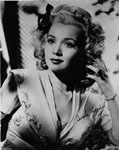 almost
say, so much the better, but in fact to understand her it is necessary to
speculate on such things, and in the absence of more solid information, to
accept, in the sense of lawyers' stipulations, the more plausible of the stories
one hears as having at least a reasonable chance of being true. If I am the
defender before history of this woman, neither whose beauty nor whose generosity
are in question, then my job is to understand her as she was rather than force
her into a mold of respectability. Carole was a creature of contradictions and
if her suicide is no reason to deny her virtues, it does suggest real
contradictions in her system of values that can't be wished away; it is this
that makes her "tragic," worthy of our sympathy, of course, but more than that,
deserving of a place in history as someone who lived and died, ultimately for
our benefit, the contradictions of our exchange system. Beauty in an atomistic
world is merely an adaptive value, a token of improved reproductive fitness; but
the world is never atomistic, and in a world of Hollywood publicity beauty
itself is far more than a biological or even a cosmetic phenomenon. If Carole
could never find a stable love relationship I don't think it suffices to
attribute her failures to bad luck or even to the specifics of her disposition.
There is a real sense in which Carole was a sacrificial victim, but it is
insufficient to point fingers at those who made her their scapegoat. The
ugliness is a fact of life, but it is the necessary underside of beauty. For
someone to be as beautiful as Carole, there had to be compensatory mechanisms at
work that would make her private and professional life extremely problematic.
Had the war not intervened, she might never have had the opportunity to show
herself as the national treasure she was; we would remember her, or I or someone
else would recall her, as the most beautiful woman of Hollywood history, and no
doubt as a good person in her personal life, but we would not realize beauty's
almost
say, so much the better, but in fact to understand her it is necessary to
speculate on such things, and in the absence of more solid information, to
accept, in the sense of lawyers' stipulations, the more plausible of the stories
one hears as having at least a reasonable chance of being true. If I am the
defender before history of this woman, neither whose beauty nor whose generosity
are in question, then my job is to understand her as she was rather than force
her into a mold of respectability. Carole was a creature of contradictions and
if her suicide is no reason to deny her virtues, it does suggest real
contradictions in her system of values that can't be wished away; it is this
that makes her "tragic," worthy of our sympathy, of course, but more than that,
deserving of a place in history as someone who lived and died, ultimately for
our benefit, the contradictions of our exchange system. Beauty in an atomistic
world is merely an adaptive value, a token of improved reproductive fitness; but
the world is never atomistic, and in a world of Hollywood publicity beauty
itself is far more than a biological or even a cosmetic phenomenon. If Carole
could never find a stable love relationship I don't think it suffices to
attribute her failures to bad luck or even to the specifics of her disposition.
There is a real sense in which Carole was a sacrificial victim, but it is
insufficient to point fingers at those who made her their scapegoat. The
ugliness is a fact of life, but it is the necessary underside of beauty. For
someone to be as beautiful as Carole, there had to be compensatory mechanisms at
work that would make her private and professional life extremely problematic.
Had the war not intervened, she might never have had the opportunity to show
herself as the national treasure she was; we would remember her, or I or someone
else would recall her, as the most beautiful woman of Hollywood history, and no
doubt as a good person in her personal life, but we would not realize beauty's
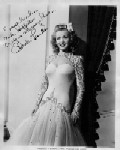 heroic potential.
Having thought about myself on the way home the unflattering thought that to defend the kind of honor for which Arabs kill their sisters is less honoring Carole than expressing a less than honorable sexual jealousy, I arrived home to find no fewer than five photographs of Carole, including a particularly lovely autograph that shows her in a white dress one could fancy a bridal gown. No, truly there is no beauty comparable to Carole's; for no one else is beauty so simple, so generous and unemphatic. All the effort at dress and makeup and hairstyling and camera placement is, pace the theorists of process, blessedly hidden from our gaze; all we see is what Carole seems so glad to let us see, this perfect model of all we can desire that so kindly spares us the perversity of desire (my friend Michael finds our so American beauty lacking in European perversity). These decently hidden efforts of production take their toll in other ways, however. Beautiful women, as the cliché goes, tend to fall for the worst sort of men. Being constantly and intensely desired by so many cannot but disfigure one's own capacity to desire. Human beings crave reciprocity, and for Carole to throw herself at someone, be it Tommy Wallace, Rex Harrison, or even Jacqueline Susann, is to show herself our equal; if her very presence inspires desire in others, then she must be precipitous with her own, doubtless not realizing or rather not caring to realize that the "own" has its mimetic source in the more solidly guaranteed desire of the Other.
To have received so many beautiful images of Carole on the very day in which I resolved to see her as she really was seemed one more sign of the rightness of my project; no doubt these images were not sent by the gods but purchased by myself, but the very will with which I purchased them was sign enough; it was this revelation of sheer beauty that had drawn me to Carole not as a sexual fantasy but as a demonstration of the possibilities of human love.
* * *
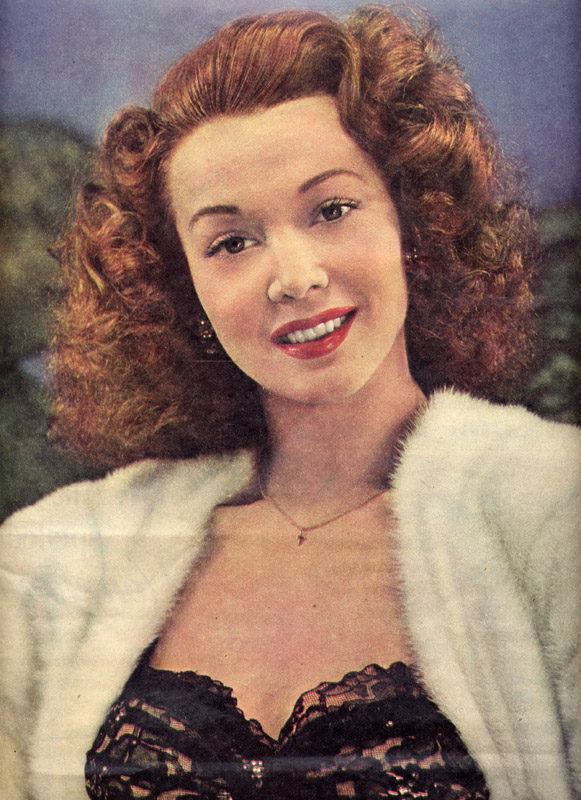 As
if these glossy photographs were not enough proof of the rightness of my
decision, I also received a color Sunday News cover from March 1947, the
image of which on eBay had been less than clear and from which I expected
little, that was to my amazement the most humanly appealing--the most
terrifying--of all the many images I have seen of Carole. I reproduce it here as
too powerful to reduce to a thumbnail. This is glamorous Carole, but it is not a
glamour shot; her hair is unblond and only moderately restrained; she is looking
at us, not at a Hollywood photographer; her bustier-type dress fifty years
before Madonna is both splendid and tasteful where the latter's is neither.
Carole's smile has enough hint of seduction to make us fear after fifty-five
years the effect of encountering her in person. Here is that grain of wildness
her detractors spoke of so maliciously because they could not deny its power of
never putting into question the grace that accompanies her beauty and that is
hers and no one else's. How could one have defended oneself from a look like
that? Yet there is nothing simpler; it has nothing to hide; in Carole's world
what is shown is ready to be shown, and what is not is never in question.
This almost unbearable radiance turned toward us with what seems but a fraction
of its potential luminosity is a gift so overwhelming that no response could
ever be adequate to it--save mine, perhaps, protected by the years and by her
absence, Perseus watching in the mirror of his shield this Medusa made dangerous
despite herself by her barely noticeable desperation to share what we cannot
hope to reciprocate, this beauty too human for our mere humanity.
As
if these glossy photographs were not enough proof of the rightness of my
decision, I also received a color Sunday News cover from March 1947, the
image of which on eBay had been less than clear and from which I expected
little, that was to my amazement the most humanly appealing--the most
terrifying--of all the many images I have seen of Carole. I reproduce it here as
too powerful to reduce to a thumbnail. This is glamorous Carole, but it is not a
glamour shot; her hair is unblond and only moderately restrained; she is looking
at us, not at a Hollywood photographer; her bustier-type dress fifty years
before Madonna is both splendid and tasteful where the latter's is neither.
Carole's smile has enough hint of seduction to make us fear after fifty-five
years the effect of encountering her in person. Here is that grain of wildness
her detractors spoke of so maliciously because they could not deny its power of
never putting into question the grace that accompanies her beauty and that is
hers and no one else's. How could one have defended oneself from a look like
that? Yet there is nothing simpler; it has nothing to hide; in Carole's world
what is shown is ready to be shown, and what is not is never in question.
This almost unbearable radiance turned toward us with what seems but a fraction
of its potential luminosity is a gift so overwhelming that no response could
ever be adequate to it--save mine, perhaps, protected by the years and by her
absence, Perseus watching in the mirror of his shield this Medusa made dangerous
despite herself by her barely noticeable desperation to share what we cannot
hope to reciprocate, this beauty too human for our mere humanity.
If you can look at this picture and not be transfixed, then I can teach you nothing about beauty or desire. No imaginable encounter could be worthy of this presence, neither from the other side nor from hers; and then we note that her eyes are not quite focused on us, aware that there is really nothing to see, no one to respond to this gesture made by the very means by which it is communicated to us too grand for any reciprocation. All the tragedy of Carole is here before us and we can do nothing even retrospectively except to conscientiously seek the truth of it, knowing that no rhetoric can more than point a beckoning finger toward this lovely and terrible image that even now I tremble to resuscitate of beauty burning to give itself.
5/31/2003
Today I wrote a first draft of my Times article; not terribly convincing, I imagine. This will be a tough nut to crack; Scott S. this evening at dinner warned me against expressing too much enthusiasm before my reader is equally convinced. There must be a strategy, especially for the opening. Yet this morning in reading yesterday's entry, a first draft not even reread, I was pleased by the tone, the literary complexity of my text that seems to do justice to the complexity of the project and of Carole. I will pursue these reflections in the morning.